Dubrovnik, Croatia

Updated: May 7
We'll be visiting two cities in Croatia over two days, Dubrovnik and Split. But one at a time.
Our local guide Maria told us that Croatia is a small but beautiful country. Small it may be, but it's much bigger than Montenegro, our last port. Croatia has a population of 3.6 million people (six times more than Montenegro) and more than 1200 islands. Another destination for nautical tourism? Absolu-toot-ly.
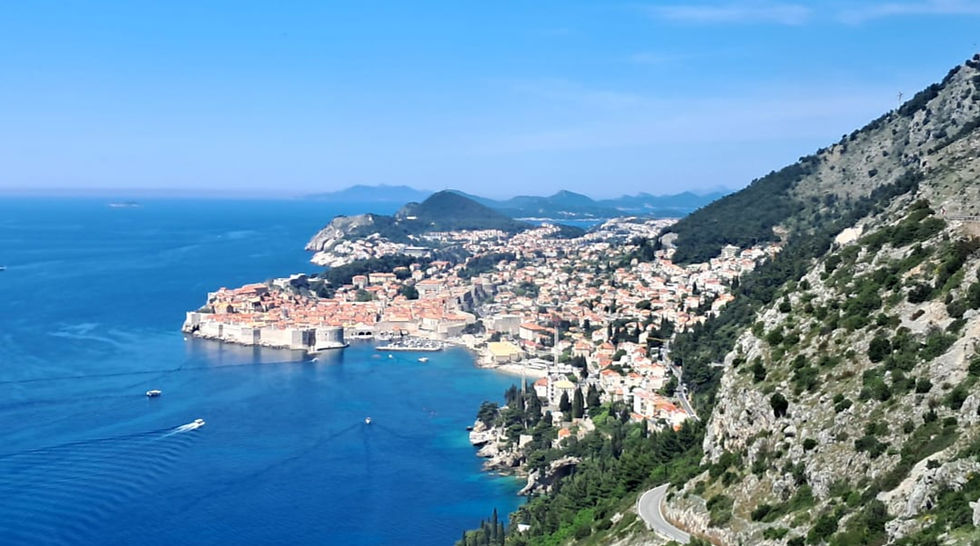
We disembarked in Dubrovnik and could see the old walled city. Any Game of Thrones fans? You'll recognise King's Landing, the capital of the Seven Kingdoms. (I'll come back to this.)
Before visiting the old city, we headed south east to the Konavle region. Look how narrow this strip of land is.
On the way we passed the cursed Island of Lokrum. The legend is that monks who'd been there for centuries were expelled by a nobleman. The monks then cursed the island and anyone who owned it. There's a long list of island owners who came to a sticky end! My advice is don't be tempted to buy the island.
This coastline is spectacular.
The Valley of Konavle is one of the wealthier regions and a wine growing and foodie hotspot. My Serbian friend recommended trout baked in a cast iron pot, which sadly we did not succeed in finding. Local grapes are malvasia (white) and plavac mali (red), a bit like the Italian primitivo. Typical trees are figs, cypress and olives. People eat a lot of olive oil. Fish need to swim three times, said Maria: once in the Adriatic Sea, once in olive oil, and once in wine.
The Ljuta River runs through the Valley of Konavle. For centuries this fast-flowing river (ljuta means angry) has been used to power mills. One family has opened its historic mills to the public. After a welcome drink and sugared orange peel, a local sweet, the owner demonstrated the process of grinding corn.
Another machine, called a stamp mill, was used to process wool fibres after the fabric had been woven from sheep and goat yarns. The woven fabrics are bundled together and placed in the machine. Then thump! thump! thump! etc. The great big stamping logs — powered by flowing water — compact the woollen fibres, and the fibres are matted together. After the stamping, the fabric looks and feels like felted wool. And it's waterproof!
Only two stamp mills in the world are still operational. This is one of them. Back in the day, people who came to the stamp mill to process their fabrics had to pay for half a day's mill time. Much more expensive than having your flour milled ...
By now it was about 9.30 am, time for a snack and some Konavle wine. That's Maria, our excellent local guide, in the first photo below. I made notes of some of her bon mots to share with you. In the second photo, you can see one of the mill hostesses. Of Croatian heritage, she's from Sydney! We had a lovely chat. She and her husband moved to Croatia about three years ago to help his ageing parents with their business. She's wearing Croatian national costume. The colour of a woman's scarf denotes her status: white is married, red is single, black for a widow, pink means engaged.
Ken's enjoying his early morning wine and prosciutto.
Off to Cavtat (pronounced tsav-tat), a popular, trendy summer resort about 30 minutes' drive from Dubrovnik. It's the Croatian St Tropez. Small ferries leave Cavtat every few minutes for a different island along this coast. It's most alluring.
Cavtat is an old Roman port. It has an underwater museum with ancient Roman ruins, so if you're a scuba diver, this destination is for you. Summer is very hot with no rain; the best time to visit is October or November. Late April was pretty good too, but definitely not warm enough to swim.
No visit was complete without a coffee and some dolce far niente.
Pause to admire the clarity of the water.

And then it's back to Dubrovnik. The city of Dubrovnik (named after oak trees) dominates this region's history. No surprise that the Old Town is a UNESCO World Heritage Site.
Going back a few thousand years, the Ancient Ilyrians and Romans lived in this area until they were conquered by the Slavs. When Rome fell, the area was ruled by the Byzantine Empire.
The old town of Ragusa, later Dubrovnik, developed around 600 CE and it pottered along quite happily until about 1200, when the Venetian Republic became all powerful. Under Venetian influence for the next 200 years, Dubrovnik became a great trading nation.
From around 1400 to 1800, Dubrovnik was an independent city-republic. It traded with Europe, India and America, produced salt (1 kg salt was equal to 1 kg gold), and was a centre for ship building – ships built here had a 50 year guarantee. Officials preserved the city by spycraft and playing off countries to the east and west. Maria described it as a small country with good diplomats. Like Switzerland, she said.
Just across the border, Bosnia-Herzogovina was ruled by the Ottoman Empire. Rather than fight with its larger neighbour, Dubrovnik paid Bosnia a tribute of 40 kg gold annually. The city thrived from espionage and diplomacy, said Maria, not the blood of soldiers.
But even diplomats need protection. Maria's advice: Prepare your eyes for city walls.
The Dubrovnik walls are mostly a double line. About 25 m tall, they stretch for nearly 2 km around the Old Town. We entered through the Pillar Gate.
The Stradun, or main street, runs through the city. Venetian style pops up frequently, such as in the Sponza Palace in the last photo below.
St Blaise is the patron saint of Dubrovnik, celebrated for warning of an impending Venetian attack and miraculously saving the city. The Church of St Blaise is the ornate white church behind the wrought iron gates below.
In front of the church is a column with a statue of a knight in armour. This is the famous Orlando’s Column. Orlando was a knight who helped people defeat invaders in the middle ages. Are you detecting a theme here? Both St Blaise and Orlando have annual festivals that celebrate them and the city's freedom.
Every square in front of every church has a clock tower. Venice again. Then there are sundry saints and noblemen who are honoured by statues. The little boy is rubbing this one's nose for good luck.
The Pearl of the Adriatic, people say. So picturesque, you say. Just the sort of place to make a movie! Dubrovnik was the setting for King's Landing in Game of Thrones, but apparently Star Wars, Robin Hood and Vikings were also filmed here.
You wouldn't think so, though. It's all GoT merchandise.

If you've watched GoT, you'll have seen this circular fountain. It's called the Large Onofrio Fountain (there's also a Little Onofrio Fountain) and has 16 sides and 16 carved masks dribbling drinkable water into a pool. It was built in the 1400s to bring water to the city from a spring. It's the prettiest place to fill up a water bottle.
We considered our options for lunch, succumbed to spinach and cheese burek, and sat by the fountain with the crowds. My peach-rose-lemon gelato was indescribably delicious.
Where were we, historically? A disastrous earthquake in the 1600s, Napoleon in the early 1800s and the outbreak of WW1. After the war, Croatia became part of Yugoslavia under Tito. Maria's view of Tito is quite benign. Pink communism, she said, not red. And I quote: Tito had charisma for a communistic person.
Then Yugoslavia broke up and Croatia fought for independence. In 1991, said Maria, pointing to the hilltop visible above the Old Town, Milosevic bombed Dubrovnik from up there. 'Up there' is the border with Bosnia (two photos below), and it must have been terrifying to be in the city.
The damage has been repaired -- it's a UNESCO site, so there's funding -- and if visitor numbers are an indicator, Dubrovnik is doing well. (Too well perhaps. So many tourists!) Perhaps it was St Blaise who saved it once again.
Here's a relaxing video from the ship after this whirlwind tour.
Next: Split, Croatia
This really looks better on a bigger screen. www.julie-anne.online


Comments