Brindisi, Italy
- Julie-Anne Justus
- Apr 30
- 6 min read
Updated: May 1
And we're back in Italy! On the heel of the Italian boot! This is where the Adriatic Sea meets the Ionian Sea.


Brindisi is in the region of Puglia (or Apulia). Couldn't resist this glorious map below.

Puglia has a distinct culture within Italy. People were living here more than 100,000 years ago; in the Bronze Age, this was the first 'industrial' area on the continent. Like many of the places we've visited in this region, Puglia has had a number of invaders and conquerors: the Greeks from 500 BC, followed by Romans, Normans, Turks and the Spanish. The latest invaders, apparently (and no, I'm not referring to the Albanians), are 'British pensioners' (I quote), who are buying cheap property in the Puglia region.
But back to Brindisi, pronounced Brin-di-si and not Brin-dee-see, population 83,000. Our guide Assunta told us that Brindisi is what Italians say when they drink (cheers!) but this is probably a happy coincidence as the old name for Brindisi (Brundisium) means deer head, the shape of the harbour.
We're here on a Sunday and it's incredibly quiet at 9.30 am (other than the fishermen lining the wall) when we stroll along the harbour promenade and find a coffee. But boy, does it liven up within the hour. Families with small children, families with old parents, many people walking their dogs. Many many dogs. There's also, curiously, a memorial to Gandhi. Behind him, in the park, an open-air church service was taking place with lots of young people.
We discovered later that yesterday was Liberation Day, a public holiday, so it's a long weekend. Liberation Day commemorates the liberation of Italy from Nazi German occupation and Fascist collaboration. (Liberation Day falls on 25 April, the same day as Anzac Day. Coincidence: one date relates to WW1 and the other to WW2.)







The Roman columns mark the end of Appian Way, the great paved stone road that stretched for about 500 km from Rome to the southern provinces of Italy, ending in Brindisi. Built around 300 BC, the road played a strategic military role and was important for trade with Greece, the Balkans and the Middle East. Do you remember the story of Spartacus? When Rome crushed the slave revolt led by Spartacus, who was heading for Brindisi, 6000 slaves who had supported him were crucified and hung along the Appian Way.
So this would have been pretty close to all that action. Here are the two Roman columns. Well, one and a bit. The other one fell over during an earthquake (this region and its earthquakes!) so only a stub remains.

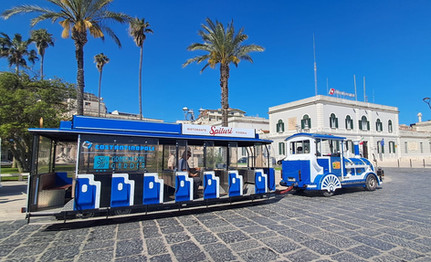
We decided to take a one-hour tour of Brindisi on the Brindisi Express. I agree with Tusci from Singapore, but I think Barbie from New Orleans is overstating it.



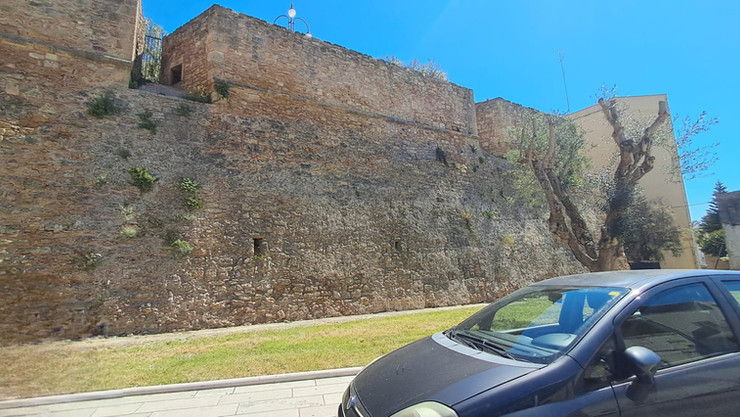
Our sense of Brindisi is that it's less tourist-y than (for example) Amalfi. It struck us as a city where locals outnumber tourists. Of course, being Italy, there's still history around, such as the castle and fortified walls that were built in the 1200s to defend against the Ottoman Turks.






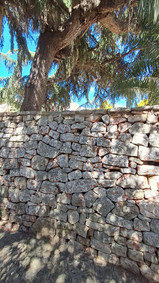


The old parts of the city still have cobblestones or paving stone streets. The more modern sections have regular sealed streets. And they're all intermingled.





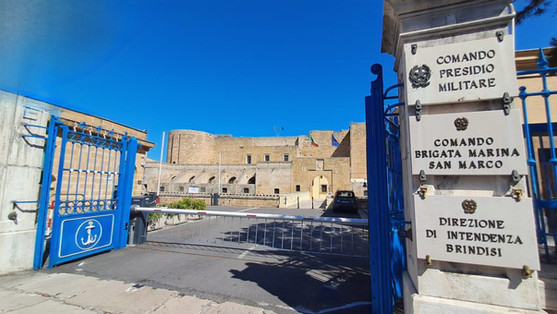
The Brindisi military / naval command is based in the old castle. There was a naval ship in the harbour when we were there; good to see that Italy's young blonde lady hasn't decided to send it to the Gulf of Hormuz.



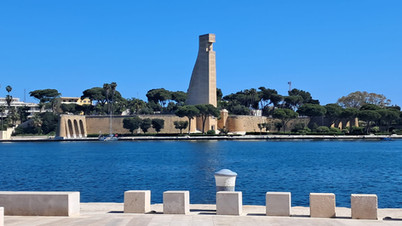
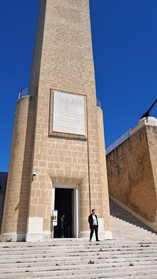
Despite looking fairly modern, the Ave Maris Stella church is medieval. It's the hub for the traditional festival of fishermen, when a procession walks from the town to the National Monument of the Italian Sailor in September. The monument is a tall structure shaped like a rudder. It was built in 1933 by Mussolini to honour the thousands of Italian sailors killed in WW1. It's one of the first things we noticed as we sailed into Brindisi, and our little Express tour-train takes us there to the other side of the harbour.







Time for a nice little Sunday stroll through the town of Brindisi. Some of you asked why I didn't mention the Mafia when we were in Sicily* but we did encounter Roberto Vannacci campaigning in Brindisi. I didn't know who he was at the time but the promotional material looked distinctly right-wing and he looked downright terrifying, so I looked him up later. Mussolini would have been proud of him. He and his, um, followers (all male) are under that gazebo tent in the square. I took a casual photo from a distance. On the flip side, these two young women were very keen to sell me a Communist newspaper. (I know it was a Communist newspaper because it was called Lotta Comunista.) I explained I don't speak Italian and gave an Italian shrug, which convinced them. Good old Italy.




Italians may not agree on politics (they don't) but everyone agrees that their food is fantastic. We had the special sandwich of the day with mortadella, rape (broccoli rabe) and straciatella, Ken had a local beer, and I was blown away by the semolina ciabatta bread roll. I'm going to try to make semolina ciabatta when I get home.



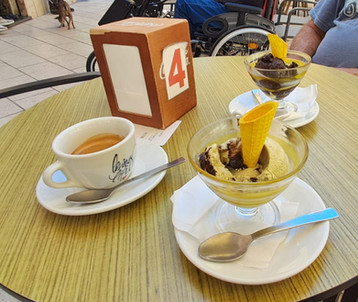
Now what we needed was a coffee and some gelato. So we moved a few cafes down the road, and hit the jackpot. This gelato was magnifico. Ken had dark chocolate that was made without sugar or milk, and it was superb. I had the best pistachio gelato ever. This gelateria was a family business that had been operating for decades, and it had won a host of awards. Good luck for us.



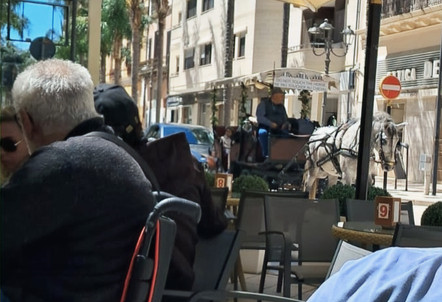
Our afternoon adventure was a visit to a small town in the hills. Puglia is characterised by these hills that run parallel to the coastline. Puglia is very popular with northern Italians, according to Assunta, because it has sun, wine (the local grape is the Primitivo variety), food, events and festivals. As a result, many people from the north of Italy have built homes along the coastline for the Italian summer.

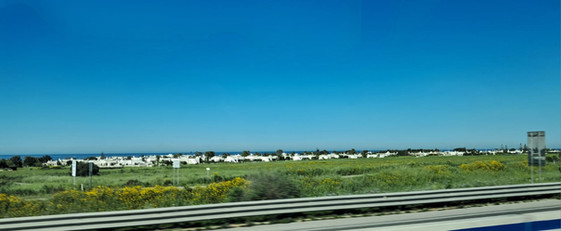

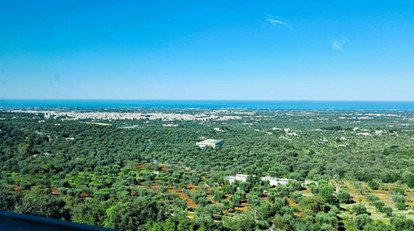


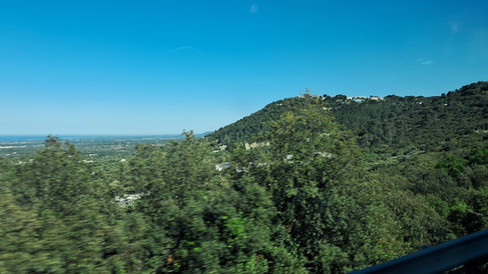

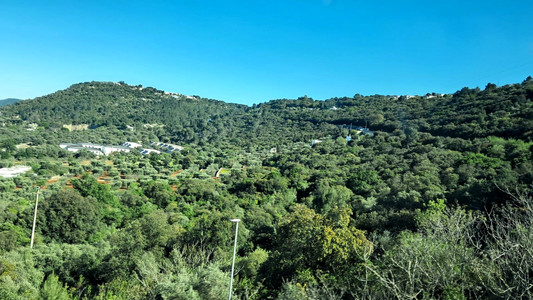
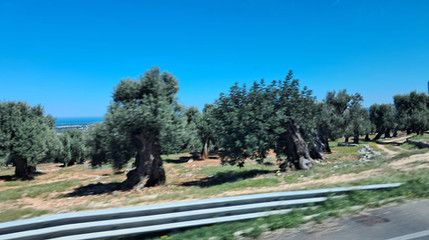
The Puglia region produces 40% of Italy’s olive oil. Apparently there are around 60 million olive trees in Puglia, and thousands of them are more than 1000 years old. I did not know that trees grew that old, but they do. The very very old trees have thick, twisted trunks.




We're visiting the town of Alberobello, yet another UNESCO World Heritage Site. Alberobello is about 80 km north-west of Brindisi, in the hills. Alberobello means beautiful tree, because the region was covered in, well, beautiful trees.
Alberobello is the town of trulli: drystone houses with conical roofs. One trullo, many trulli. Alberobello has 1500 trulli.







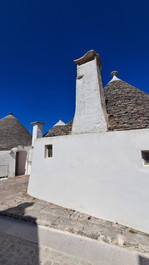

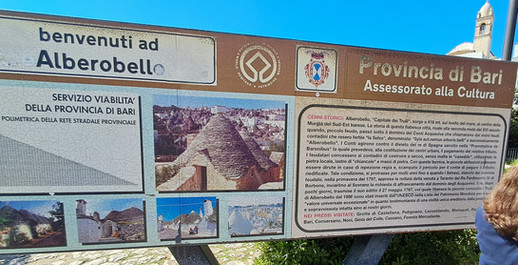
The earliest trullo goes back to 1495. They were built by agricultural workers for both shelter and storage, and the conical roof was shaped to accommodate tall farm implements that needed to be stored. The sloping roof also facilitated water storage; the rain would run off the roof into cisterns below. The materials used to build the trulli were stones and slate found in the fields.
Today trulli are popular with tourists, and most of them have been renovated inside and are rented out as B&Bs. Lucky are the locals whose (poor) grandparents bequeath a trullo to them! They were considered a sign of poverty in the past, but today they are in high demand by foreign holidaymakers.


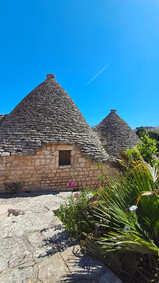





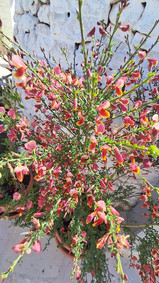





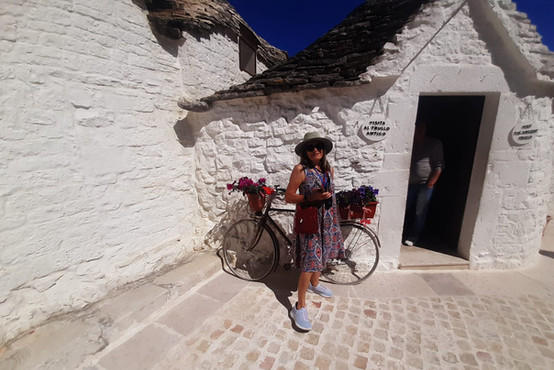
Of course, where there are tourists, there's food and wine and sunshine and music ... and many shops. The streets slope upwards, out from the central square.


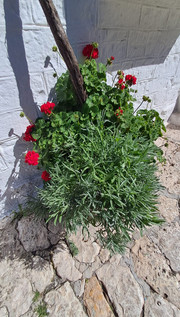


I wandered into one shop and the owner asked if I'd like to see the view of the town from his rooftop terrace. The view was splendid and yes, I did buy a small souvenir from him.



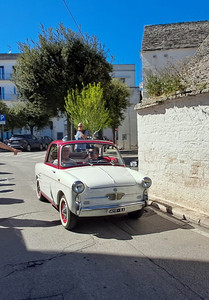
No cars are allowed inside Alberobello, but Ken spotted this old Fiat (twice!) in different spots outside the town. How cute is that. It's like a toy car.



While the trulli are concentrated in the central historical town of Alberobello, the conical roof shape continues in the immediate area surrounding the town.


We learned a lot today, mainly about trulli.
I have been wondering about all these UNESCO World Heritage Sites that we keep visiting. Italy has the highest number of World Heritage Sites in the world — 61 — so no wonder we keep bumping into them. (China has the next highest number: 60.) If you're interested, here's the UNESCO information about the trulli of Alberobello.
Leaving Brindisi now and heading across the Adriatic, to the Balkans.

Next stop: Kotor, Montenegro
*We didn't notice anyone behaving suspiciously! Ken said it was too early for the Mafia to be out. :)
This really looks better on a bigger screen. www.julie-anne.online


Comments