Valletta, Malta
- Julie-Anne Justus
- Apr 25
- 6 min read
We had to skip the port of La Goulette, Tunisia, because of the heavy fog that settled over the water ALL DAY. All we saw was blue and white. The Tunisian port officials require 2 km visibility for ships entering the channel: the fog allowed less than 1 km. So no Tunisia. Boo.


We sailed east and docked in Valletta, Malta.
We're on the main island Malta; the other main islands are Gozo and Comino, which we didn't see. Malta is a very small country, just over 300 square km. Almost 600,000 people live in Malta, which makes it the the most densely populated country in the EU.


Malta has good natural harbours and occupies such a strategic location in the middle of the Mediterranean Sea that it's no surprise it has been occupied by so many different people: the Phoenicians, Romans, Greeks, Arabs, Normans, Sicilians, Germans, Spanish, French and British.
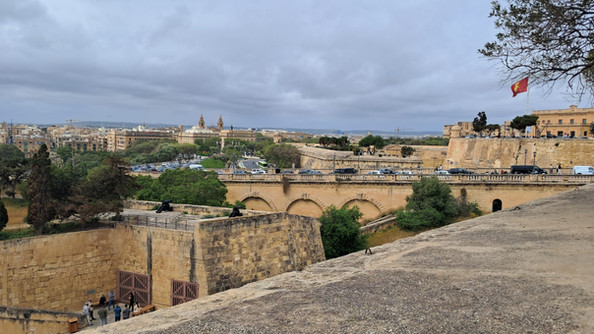
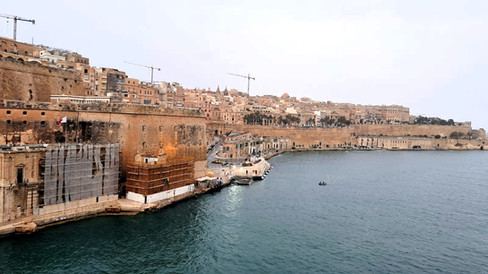
The whole town of Valletta is a UNESCO World Heritage Site. We had grey skies as we sailed into Valetta Harbour. The remnants of the foggy weather further south, perhaps. The walled city looks very Game of Thrones and Gladiator-ish, which isn't surprising as both were filmed here.


The old hospital built by the Knights of St John in the 1500s is now the Valletta Convention Centre, connected to the harbour by an underground tunnel. In the Convention Centre we saw a documentary about Malta's history. I knew a bit about the last 500 years, but I didn't know about Malta's fascinating Neolithic history and the famous fat ladies. More about them in a footnote if you're interested.*



Anyway, jump to medieval times. The Knights of St John, or Knights Hospitaller, were a Catholic order founded to care for pilgrims in Jerusalem. This was during the Crusades; over time, they became a military force in the Holy Land (aka Palestine and Israel — a hotbed for centuries). The Knights were expelled by the Turks to Rhodes** around 1300. From Rhodes they were expelled to Malta around 1500.
The Ottoman Turks really didn't like these chaps, because they pursued the Knights and laid siege to Malta ('the Great Siege of Malta') in 1565. Led by the Frenchman Jean de Valette, the Knights succeeded in defending the island. You can still see some of the damage done by cannons in the walls. The fortified town of Valletta was built after this siege, and named after De Vallette. Ken is astounded that the fortified town took just five years to build! You can see by the walls below that sometimes they dug down into the sandstone, rather than building up walls.



Around 1800 the French (Napoleon!) invaded the island and expelled the Order, only to be defeated in turn by the British. Malta then became part of the British Empire until 1964, when it gained independence. It's now part of the EU.
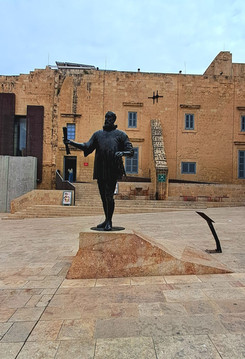
It's a very Catholic country. Catholicism is the state religion and more than 80% of the population identify as Roman Catholic. The statue in the first photo below depicts Malta bowing down to Christ.


Valletta is a picturesque town with lots of Baroque architecture, often described as an open-air museum. It was named the European Capital of Culture in 2018. The last photo below shows Castile de Aragon, the PM's residence. (Aragon was one of the Knights' langues, so this was built for the knights of this 'chapter'. There were eight langues — this was medieval times and pre-statehood in Europe, so these were based on geography and language: the Crown of Aragon, the Crown of Castile, Auvergne, Kingdom of England, France, Holy Roman Empire, Italy and Provence.)




The Upper Barrakka Gardens are public gardens that overlook the Grand Harbour. There's a battery of saluting cannons on the next level down, which fire every day at midday and 4 pm. The gardens were originally built by and for the knights of the Italian langue.









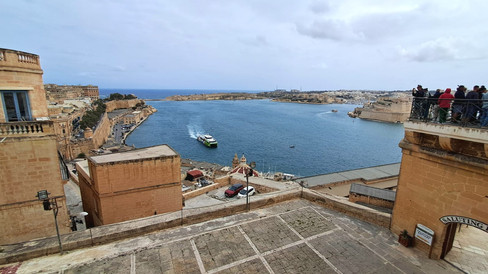


The garden walls are lined with memorials for a range of people (such as Churchill and Einstein) as well as soldiers in the Second World War.







Horse-drawn carts are common in the town ...

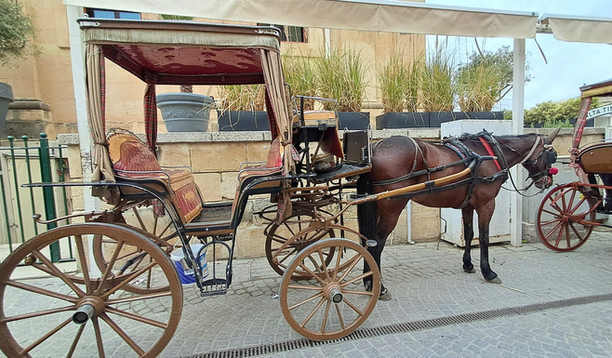


... and we noticed horsemeat on almost all restaurant menus. Rabbit, too.

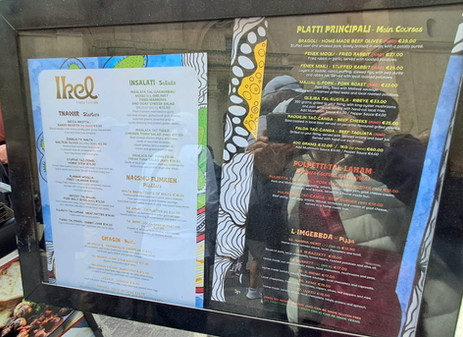



I was very intrigued by the Maltese language. It's a mixture of 40% Italian (actually a Sicilian dialect of Italian), 40% North African Arab and 20% English. I recognised a lot of Arabic words on the Maltese signs. Schools teach English so most Maltese people speak English as well as Maltese.


This restaurant, Cafe Teatro, is next to the Old Opera House. Its menu shows how the opera house used to look.



But then came 1942. Malta had this hugely strategic location in the Med, and in an effort to destroy it, the Axis powers bombed it to smithereens. It was bombed 3300 times over 154 days. Britain awarded the George Cross, which recognises extreme bravery, to the island of Malta in recognition of the courage and resilience of its people.
I'm sure this made everyone feel much better.
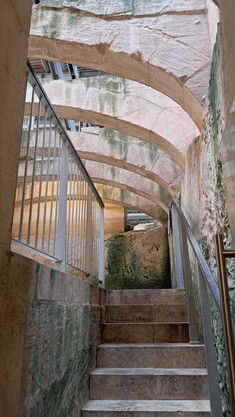
The Opera House was blown up, of course. After the war, Valletta decided not to rebuild but instead to use the ruins as an open-air performance space in summer, when there's very little rain. It's a great idea that both memorialises the bombing and uses the space creatively.




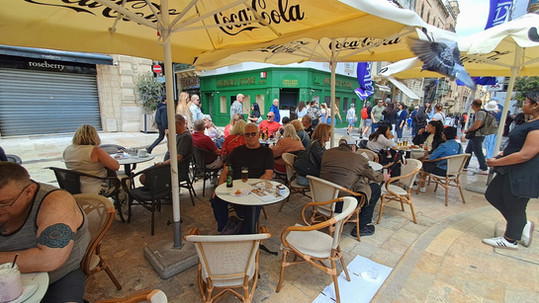
Ken decided it was time to try a Maltese beer; I wanted to try Maltese pastizzi. We had one filled with chicken, one ricotta and one anchovy. Fabulous! Amazing flaky pastry!



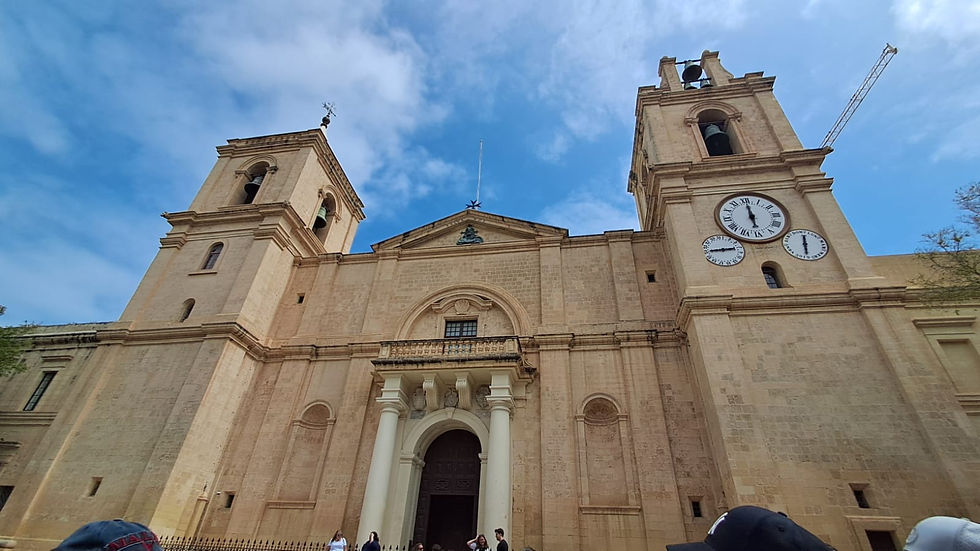
Another church! But this one is special. St John's Co-Cathedral was built by those energetic Knights of St John in the 1570s. There is another Cathedral in the city of Mdina but this one has been named as 'co-cathedral'. The outside facade is very plain, except for these three clocks that tell the time of day, day of week, and day of month.
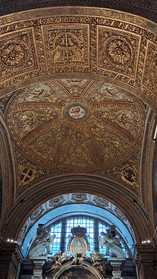
Inside, however, is another story. High Baroque! Sky-high Baroque! It's fantastic. A real case of mine eyes dazzle. The cathedral contains nine chapels, one dedicated to Our Lady of Philermos and the others dedicated to the patron saints of each of the Knights' eight langues.












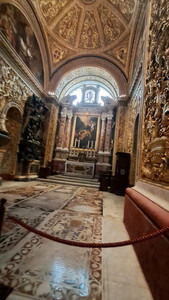


This little angel has a trumpet that was too long to fit into the spot on the wall, so the plaster had to be chipped back to fit the tooter. I can just hear the rage from the 16th century.

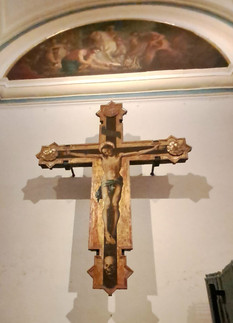
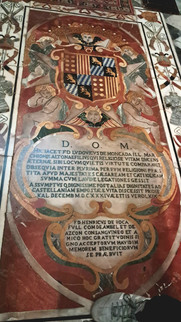
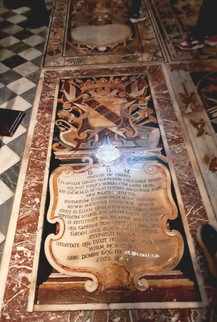
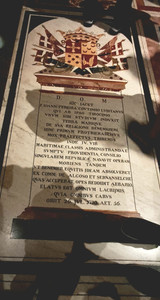
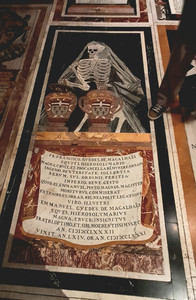
The church has a number of mausolea; the Knights obviously liked being laid to rest in this busy Baroque environment. I particularly liked the marble floor. There are 405 elaborately inlaid marble tombstones for various Knights of St John. I would have liked more time to explore them.




The peak experience in this church is the chapel containing the masterpiece by Caravaggio, The Beheading of St John the Baptist (1608). Caravaggio is famous for (1) his use of chiaroscuro and (2) killing a man in Rome and then fleeing to Naples and then Malta where he was commissioned to paint this picture. It's stunning. It's considered one of his masterpieces, it's the largest thing he ever painted and the only one signed by him.
Caravaggio painted it for this spot precisely. The circle of light that illuminates the beheading in the painting looks like it's coming from the sunlit window in the church roof above. The more you look at it, the more you wonder what is natural light and what is painted light. You need to see it in situ. The photos don't capture the subtlety,although I tried a few times.


We recovered from that artistic experience with a coffee and eclair in the square outside the Co-Cathedral.

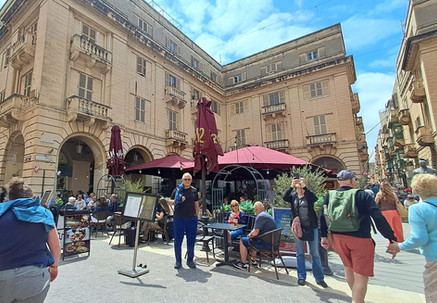


The sun had come out as we walked back through the town to the gardens. The Chinese lanterns were hung by the China Cultural Centre (note the Chinese flag) to celebrate its 20th anniversary.





We decided to take the lift from the Upper Garden down to ground level, for €1 each.




Whew. A lot to absorb in one tiny city. And there are contradictions! For all its long and complex history, Malta appears to be very modern. Our guide Martin mentioned that one of the biggest industries in Malta is online gambling. I found that interesting so I looked it up later, and this is what the European Commission says. One in every thousand Maltese people works in this industry.
Online gambling is a cornerstone of Malta's economy, contributing approximately €1.5 billion (around 12.4%–13% of GDP) annually, with the sector steadily growing. The iGaming industry employs roughly 6,500 people, driven by a well-regulated framework, attractive fiscal regimes, and high-value jobs. Casino games dominate the market, accounting for 73% of online revenue.
Interesting, hey.
Time to leave Valletta. I'd love to see it next time in sunshine all day.



Next stop: Argostoli, Kefalonia, Greece
*The Megalithic Temples of Malta are older than Stonehenge and the Egyptian pyramids, and are some of the oldest free-standing structures in the world. They're also a UNESCO World Heritage Site, renowned for their massive structures, sophisticated engineering and astronomical alignment. And the fat ladies, of course. I'm sorry that we didn't have time to visit some of the temples while we're here.

**We first encountered these Knights in Rhodes a few years ago. Another beautiful walled town.
This really looks better on a bigger screen. www.julie-anne.online


Comments