Koper, Slovenia
Heading north in the Adriatic Sea, along the Croatian coastline, and our next stop is Koper, Slovenia. Slovenia is tucked in between Croatia and Italy, with a tiny 45 km coastline of its own.
Koper's old name was Capodistria, or Capo d'Istria, in its Italian past. That's more familiar! It's history is closely tied to Italy, and Trieste is only a half-hour's drive away from Koper.
Koper is on the Istrian pensinula (hence Capo d'Istria), the largest peninsula in the Adriatic Sea. It stretches across three countries, mainly Croatia (90%) with smaller parts in Slovenia and Italy. It's the prime location for truffles, which (spoiler alert) we did not have.

This area has a distinguished prehistoric record — it's where (possibly) the oldest musical instrument has ever been discovered (a flute made from bear bone) as well as the oldest wooden wheel. Somewhat more recently than 250,000 years ago, this region was occupied by the Roman Empire and the Venetian Republic for centuries. That should be no surprise since Venice is just a hop across the Gulf of Trieste. When Venice's star set, along came Napoleon and the French, followed by the Austrian Empire, then Italy. It still has a significant Italian influence and is bilingual (Croatian and Italian).
Capodistria had a population of 2 million people at its peak; post-WW2, it was actually part of the city of Trieste. Koper now has a population of 28,000. The huge decline came when Slovenia became part of Yugoslavia in 1954 and the majority of the Italian population left the area. It became a ghost town, said our local guide Natasha, when the Italians 'fled'.
It seemed a bit of ghost town to us, too, because we arrived on a public holiday — 1 May, Labour Day ... and at 9 am, the town was virtually empty. It did fill up with families and cyclists (more on that later) as the day wore on but it was Very, Very Quiet in the morning.
The first large square we encountered was Tito Square, named after the Yugoslav leader. We're big fans of Tito, said Natasha, because Tito helped free this country from fascist Italy. And in 1976 Tito brought Fidel Castro* to Koper! A major event for any Communist town!
Like other cities on this turbulent coast, it's a fortified city. It has many traces of medieval Venice, including the 900 year old church bell. Today the old Venetian palace houses the City Council.
We noticed the symbol of Venice quite often: the lion with wings. Natasha explained that the open book represents law and peace. If the book was closed, it meant Venice was at war. Our guide in Venice had a different story, but let's go with this for now.
Such an old square, and with such a pedigree ... is it a UNESCO World Heritage Site? To make the grade, all buildings have to retain their original design, materials and workmanship. Natasha described how the UNESCO team arrived to assess the site. The city held its breath. Unfortunately the pink building in the corner had been rebuilt in Tito's time, so this disqualified the entire site from heritage listing and UN funding.

We had a delightful walk around the Old Town. I've become a bit obsessed with alleys in these old towns, as you can see. And Venetian balconies.
There's a charming deshabille to some buildings. These beautiful Venetian tiled facades look like they're hanging on by the skin of their teeth.
In the old days, every house had its own well in the front garden. This is one of those regions that has a lot of subterranean fresh water.

And salty water too ... Like other towns we've visited on this trip, historic Capodistria/Koper had saltworks that produced salt of enormous value. Salt — required to preserve food — was traded as a major commodity.
Where there's money, there's skulduggery. We saw a number of fearsome drop-boxes where people could send anonymous notes to denounce salt smuggling. (The Stasi before the Stasi!) The arched, open building is at the port. It was used to store salt before it was loaded onto ships for trade. As in Sicily, salt is a popular souvenir from this region; we saw a number of specialist salt shops as we explored.
This is the narrowest house in Slovenia. Natasha told us how it was the duty of fathers to provide a house for their daughter on marriage. This particular woman did not marry, so her father rather ungraciously built this house for her between two buildings. I think the Venetian balconies are a touch ironic. I mean, are they balconies at all?
We walked past Koper's, nay, Slovenia's most famous shoe shop — the shoemaker had clients from all over the world, until he died a few months ago — and some displays of Slovenian crystal. Slovenia's most notorious export, Melania Trump, apparently saved Slovenia's struggling crystal industry when she asked her husband to invest in it. Natasha said the designs have become less Baroque and more modern; I wonder whether Slovenian crystal will make its way into the Trump ballroom?
But wait, you ask, where is our early morning prosciutto and wine? Well, I'm sad to say that the prosciutto never appeared on this side of the border, but some wine was served with focaccia. Not the same thing at all, but Ken made do. On the other hand, I was tremendously excited when I saw kremsnita in the cafe fridge. Remember that krempita in Montenegro? It wasn't as pretty as that lovely curly wavy custard in Kotor, but it was just as delicious. And I do admire the way the tart was served, with the fork stuck into the side at half-mast. It was a pretty venue, too, on the marina.
Yes, those are palm trees you can see next to the marina. Bizarre. Natasha told us about a city mayor who (very contentiously) planted these a few years ago, to mark his success in securing a deal with Miami to have cruise ships dock in Koper. As we all know, cruise ships bring €€ to any town. Last year there were 83 cruise ships that stopped in Koper. Ken and I are not shoppers, but we always spend some money on local food, at least. Work it out for yourself!
Time for a long walk along the coastline. The promenade stretches out around the curving bay. I was utterly enchanted by the public benches made from limestone, every one different. I had to sit in every single one of them to test them out, so our progress was quite slow, but I can personally vouch for the fact that they were far more comfortable than the standard public benches that we're all used to. Aren't they wonderful?
Koper is a major port for the landlocked countries of this region, such as Austria, Hungary and Slovakia, and we saw a number of container ships entering and leaving the harbour while we were there. In the context of the Trump-Israel war, this was a good thing. Not very picturesque, but good for the world economy! Slovenia is a high-HDI country, has a strong economy and is a member of the EU. Industries include tourism, shipping, insurance and banking — it was the most developed region when it was part of Yugoslavia, said Natasha.
Like most (all?) of the beaches in this part of the world, they're pebble beaches. It was only about 21°C (still chilly for me) but people were out enjoying the sun.
These photos look a bit bleak, but it was very family and dog friendly, very neat and tidy, and well ordered. Three teenage boys were actually swimming, which I thought very brave. I couldn't even put my hand in the water.
There were lots and lots of cyclists! As the morning wore on, and people emerged, so did the bikes. It's obviously a very popular past-time. As a cyclist, I can understand why: there are dedicated cycle paths, lots of parking for bikes in the city, and perfect weather — wind-free and warm-ish. If people weren't cycling, they were on roller blades.
But don't take my word for it. On the cycle path along the bay, an automated counter registers the number of cyclists. There is a very popular cycle route from Koper to a town called Izola along the coast: about 7 km of fabulous views, easy gradients and great coffee at the other end. So far today, and it's about 11.30 am, 554 people have set off along this route. Almost 98,000 this year so far ...
It was on this walk today that I finally spotted the Dalmatian! Does it even count since we are no longer on the Dalmatian coast?

We strolled back into the town ...
... and paid a short visit to the Koper Regional Museum housed in a Venetian palace from the 1600s. Unfortunately for me, our visit had to be curtailed as they were closing at 1 pm for the public holiday. I thought it was interesting for a small town; it drew heavily on the Italian-French period in its history with a strong focus on Napoleonic era items.
My favourite was the medieval stuff, like this Dance of Death fresco from a church in the 1400s.
The courtyard was pleasant. There's the Venetian symbol again, over the gate to the courtyard, plus a smattering of Roman statues. Oh, for those palace days.
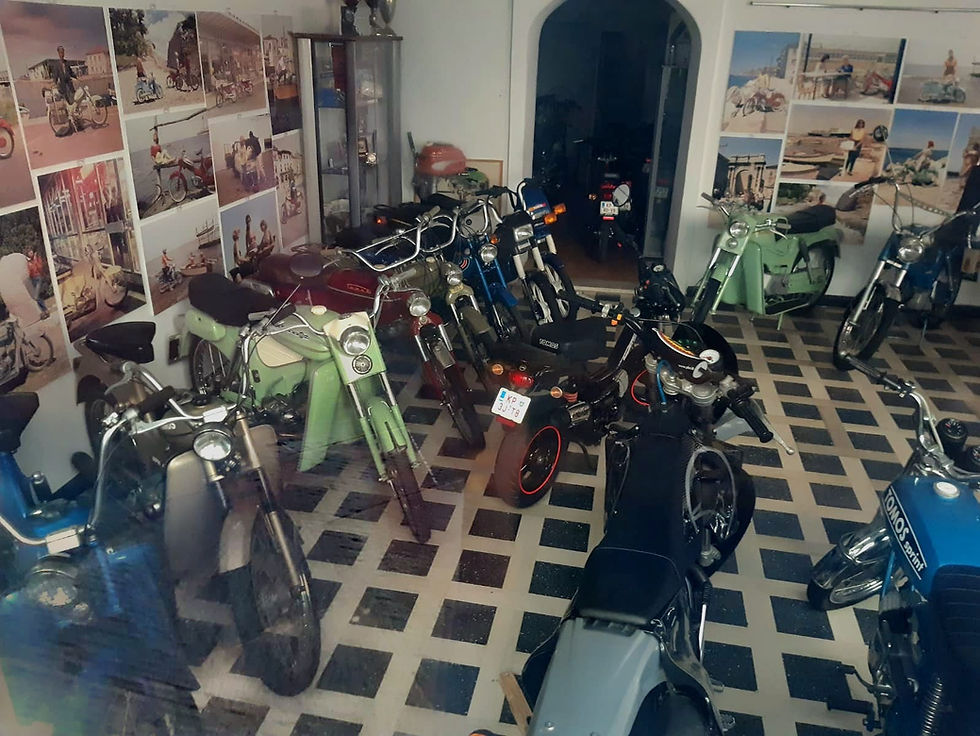
I take photos of museums, Ken takes photos of motorbike shops. These are some sort of Eastern European motorbike that Ken was fascinated by.
A second square, Prešeren Square, is the site of the ancient gate to the town within the fortified wall. A local hero, Santorio Santorio, created the first thermometer that could be used for medical use in the 1600s, and is celebrated throughout the town. Does the fountain design remind you of anything? The Fountain of the Common People, built in the1600s, has the same architect as the Rialto Bridge in Venice.
Time for a late lunch. There've been plenty of allurements, but we wanted some ćevapi before we left this region. I was tempted by polenta on many menus, but resisted.
So we found a small pub, where the owner was smoking and chatting away to his friend outside, but was happy to cook for us. He offered to make us a plate of his specials. Pork, beef, raw onions, chips, bread and an outstanding tomato-capsicum relish, and with a large beer, for less than €20. We'd go back if we could!
We popped in quickly to the Koper Cathedral in Tito Square, properly the Cathedral of the Assumption of the Blessed Virgin Mary. It's been built in various styles and has had a chequered history. Its nadir was probably during Tito's rule, when communism forbade the practice of religion. I was very intrigued by the seemingly more modern paintings of the Stations of the Cross, but have been unable to find any information on them.
Never too late for a gelato! Pistachio again, per favore.
Next stop (and last of this trip): Venice
*There's a well-known photo of Castro's visit to Koper. I could swear we went past that same cinema. And I found a video, of which the most startling thing is that the leaders drive away in open convertibles only metres from flag-waving crowds. A simpler time in politics. Not less violent, maybe, just violent in a different way.
This really looks better on a bigger screen, www.julie-anne.online


Comments