Tahiti, French Polynesia
We're in Tahiti. It's a beautiful place.

Tahiti is an island (one of 121) in French Polynesia. The islands are scattered across 2000 kilometres of the South Pacific Ocean, and some are really tiny. Many are atolls, a circular coral reef that surrounds a lagoon, and many are uninhabited. French Polynesia is just to the east of the International Date Line. We left Melbourne on Monday at midday and arrived in Tahiti on the same Monday at 1.30 in the morning.
If you look at a map of Tahiti (and handily, you'll find one below), you'll see that it looks like two islands, joined by a narrow land bridge. Those two blobs are ancient eroded volcano cones. The big blob is called Tahiti Nui (Big Tahiti) and the smaller blob is called Tahiti Iti (Small Tahiti).
Tahiti is about half the size of Mauritius and a bit bigger than Singapore. As small as it is, Tahiti makes up one-third of the total land area of French Polynesia. Of the 280,000 people who live in French Polynesia, 190,000 of them live on Tahiti.

We stayed in Papeete, the capital, but our very full day tour took us all the way down the west coast. See the town called Teahupoo in the south? On the small blob? That's where the road ends. Tahitians call the stretch from Papeete to Teahupoo the west coast.
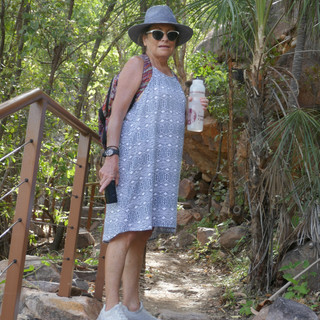
Our guide was the excellent Roni, who was born in Slovakia, played high-level water polo, lived in Israel and Bali, has travelled the world and is married to a Tahitian woman. They have a 3 year old son, Emil. Roni speaks Slovak, French, English and is learning Tahitian. He plans to start Tahiti's first water polo team when his son is a little older ...

That's the island of Moorea behind Roni. We'll be going there after Tahiti. So a quick geography refresher.
There are five archipelagoes or groups of islands in French Polynesia:
Society Islands
Tuamotu Archipelago
Marquesas Islands
Gambier Islands
Tubuai (or Austral) Islands.
We'll be visiting seven islands. Four are in the Society Islands: Tahiti, Moorea, Raiatea and Bora-Bora. Tahiti is the largest island of the Society Islands. Fakarava and Rangiroa are in the Tuamotu Archipelago, and Nuku Hiva is in the Marquesas Islands.

But let's stay with Tahiti.
Tahiti has both black and white sand beaches. The white sand beaches are created from the coral reefs. The black sand beaches are formed when rivers come down the mountains bringing volcanic rocks with them. Over time, the rock breaks down into black sand deposited on the edge of the sea. The sand is fine, quite sticky when wet, and it retains the heat of the sun — so walking on a black beach is much hotter than a white beach. Fruit trees grow naturally on the beaches: almonds, mangoes, sea grapes (delicious little cherry-like fruits).
Tahiti has a lot of natural water. Streams flow down the mountains all year round and clouds form continually above the caldera. In this stream Roni showed us the Polynesian freshwater short-finned eels. They are considered sacred by the Polynesians so are not caught or eaten. Au contraire, mes amis! People feed them like pets. Roni described there being a container for food scraps in every house — for the household's local eels.
According to tradition, the original Tahitians arrived from another Polynesian island, Raiatea. They set up political systems, organised in extended families, built temples, and the high chiefs reigned supreme — with some supernatural beliefs to support them.
This is the Marae Arahurahu, a temple and meeting place where Polynesian people would traditionally gather. Actually, they still do for festivals and celebrations. The carved statues are tikis, which represent characters in legends.
The high priest in the marae would also preside over the ceremonies for the dead. In Polynesian culture, scars and tattoos reflect important events and achievements in the life of the individual. Without the person and his/her skin, those events would be forgotten. So the priest preserved the corpse for as long as possible, wrapping plant leaves and bark around to keep the skin, um, readable.
This waterfall was one of the sacred areas for the dead.
The Polynesians did not have a writing culture, so they could not record their history in words and books. (Skin had to do.) But they were the best navigators and sailors the world knew in ancient times. They could navigate by the stars and the waves to New Zealand, to Hawaii.
The waterfall is in the Vaipahi Water Gardens, a very lovely place with or without dead people.
But that was all in pre-colonial times. The British arrived in 1767 and the French arrived in 1768, the latter claiming it for France. Other famous visitors around that time were Captain James Cook and William Bligh in HMS Bounty. A busy time for the locals!
The first permanent European settlers were Protestant missionaries from London, in 1797. In a very un-Christian manner (or was it?), they helped the local Pomare family gain control of the entire island. The Tahitian chief established a Christian kingdom, but this enraged other Tahitian leaders and there was much discontent. Another snake in the grass emerged when European traders and beachcombers arrived, along with disease, prositution and alcoholism, those trusty compadres of colonialism.
When the Tahitian queen deported two French Roman Catholic missionary priests in 1836, the French despatched a warship to demand reparations. By 1880, Tahiti was a French colony.
Today French Polynesia is a semi-autonomous French territory, like New Caledonia or Reunion in the Indian Ocean. France oversees defence, foreign affairs, monetary policy, and law and order. The local police officers, for example, are gendarmes and their uniforms and gear come from France. Tertiary education? There is a University of Polynesia in Tahiti but if French Polynesians want to study law or medicine or engineering, they go to uni in France. All free.
This is the Mairie de Papeete, the town hall, and the Cathedral Notre Dame built in French style in 1875.
Sadly these rather pretty French-style buildings are not representative of Papeete architecture, which is functional and rather boring. Papeete has a very forgettable city centre. But the natural surroundings — the beaches and the hills and valleys — are spectacular.
Tahiti is a very fragrant, flowery isle. We were welcomed at the airport with garlands (leis) of frangipani and gardenia. Flowers abound. The yellow flower below is called purau, a type of hibiscus. It's white when it blooms in the morning, becomes yellow late morning and turns red or purple by evening. In another photo, Roni is demonstrating the tall spikes of the shampoo ginger plant. You squeeze the water out of the flowers and it produces a soapy liquid that is used as (surprise!) shampoo.
We stopped at the Monoi factory where fragrant oils are produced for the world's cosmetic industries. Flowers are macerated in cold-pressed coconut oil; each of these vats takes 60,000 flowers. Tahitian gardenia (tiare), the national flower, is the signature scent. I succumbed to some body lotion: I doubt this will be my last fragrant purchase.
Way down the west coast, Teahupoo was the site of the surfing competition in the 2024 Paris Olympic Games. It was the only event that took place outside Paris. Roni (a keen surfer himself) told us how the locals were happy to host the world's top surfers (and the world's press, and the hangers-on) but they resisted having their neighbourhood spoiled by new buildings. So a cruise ship was moored offshore and that became the Olympic village for the event. Fantastic!
And the best thing of all? The local boy won the Olympic gold. True story.
But where's the surf break, you ask? What makes this the best surf break in the (French) world? On the day we went, there was very little surf. It was a beautiful, calm day, i.e. a total washout for surfers. So I'll show you some photos of photos of the surf break, on notice boards at the beach. Apparently on a 'good' day, the waves can be 10 to 15 metres high. Roni offered us a boat trip out to the reef, but given the lack of surf and surfers, we opted for a walk instead.
We had lunch in a little bistro next to the sea, on the sea sand. In Tahiti there's a lot of poisson cru, raw fish marinated in lime juice and coconut milk, a bit like ceviche. But on this occasion we opted for prawns and salad. (We have eaten a lot of fresh fish here. Freshly caught mahi-mahi and meka — cooked — were delicious.)
Here's another spring that bubbles from the mountains, this one warm-ish. It's a favourite spot for locals. It reminded us of our favourite waterholes in Darwin. Without the crocodiles, of course.
Our final stop of the day was at the Grotte de Maraa. There are three caves; this is the biggest. It stretches much further than it appears in these photos.
Some of you may associate French Polynesia with French artists, such as Paul Gauguin who lived on Tahiti. There's a road named after him but locals don't hold him in high regard: instead, they see him as a dirty old paedophile. He married a 14 year old Tahitian girl and had sexual relationships with other younger girls while infected with syphilis. So there's been no rush to renovate the small museum in Papeete that commemorated his work, which closed about 15 years ago when it became a bit run down.
A few assorted photos before we leave Tahiti. Included are a representative dog and chicken, which roam around everywhere. Roosters crow all night. Not at daybreak: all night. It's an acquired skill, sleeping through cock crows. Also included are a cunningly designed telecom tower, a grave in someone's front yard (no longer permitted), locals enjoying their beautiful beaches, our hotel's restaurant and fresh fish dishes, our hotel's black sand beach, and one example of a glorious sunset.
Next stop: Moorea.
Are you reading this on your phone? Like most things, this blog looks better on a bigger screen. Launch your browser (Chrome, Edge, Safari) on your laptop or tablet and type in www.julie-anne.online. The latest post will appear first.


Comments