Porto Belo and Rio Grande, Brazil

Updated: Aug 25, 2024
Further south on the Brazil coastline, we docked at Porto Belo in the state of Santa Caterina. Porto Belo is a sleepy, charming little coastal town ...
... but across the bay from Porto Belo is the modern, uber-fashionable coastal resort of Balneário Camboriú. Let's just say that, from experience, Google Map's estimate of a 30 minute car journey is hopelessly optimistic in the face of peak season coastal resort traffic.
Balneário Camboriú is like the Gold Coast on steroids. Pirate-themed ships, restaurants and memorabilia abound. Apparently Neymar has an apartment (or maybe it was an apartment building) here. It certainly seems like a glitzy place that celebs would like. To be fair to Neymar, it's not very far from his home town Santos.
A cable-car (yes, another one) connects the town to the tourist park at the top of the green hill, and then another cable-car goes directly to the very very popular beach called Laranjeiras. Apparently this is the only cable-car in the world that connects a town and a beach, and all I can say is: there was a long queue to get on the cable-car. A very, very, very long queue.
A small but very determined theme park is situated at the mid-way station, with children's rides, a few walkways and some shops.
But on to Laranjeiras beach. We were so looking forward to a swim, after the traffic and the mindboggling queuing. It looks like a very beautiful beach from a distance ...

... but is is very popular. Outcome: we did not swim at Laranjeiras beach.
It was with great relief that our last port in Brazil was the much more laid-back, less touristy city of Rio Grande. Rio Grande is the port city for the southern-most state in Brazil, Rio Grande do Sul. Both Rio Grande ('big river') and Rio de Janeiro ('river of January') were named in error; neither of them are rivers. But the Spanish explorers who named them thought that the big sea harbours were rivers, and called them thus, and so here we are.
We had a wonderful welcome from a group of local youngsters in traditional dress. The group performed songs and dances, but sadly I wasn't able to capture those as we were getting off the ship while it was all happening.

Rio Grande is an important industrial centre: it's Brazil's second biggest port and it has a petroleum refinery. The day may have been cloudy but it was warm and balmy. Rio Grande's colours probably look better in sunlight, but I rather liked this city --- although many of its beautiful old buildings look like they could use a wash.
The cobblestone streets are very bumpy (and slow) to drive on but they are a heritage feature of the city and cannot be changed. Our guide pointed out that, unlike sealed or tarred roads, cobblestones are environmentally friendly, as the water drains back into the ground between the cobblestones.
Most thrillingly, I was interviewed on camera for local TV by reporters from the Town Hall, who asked me for my impressions of the city. The young woman translator was surprised to hear that we were from Australia, as the crew thought our group was all from the US or Canada. (Actually, most passengers on the ship were indeed from the US or Canada, but there was a good portion of UK visitors too.)
The local police and militia were out in force, making sure that the tourists were protected from the local banditos. In fact, I have no idea what they were protecting us from, but certainly they were keen to ensure that no criminals took advantage of these (largely) elderly and (largely) naive North Americans. I asked permission to take the photo and received a stern nod, so here they are. Our guide (in green shirt) explained that there were two types of police: the city police and the city militia. Each has their own chain of command and operate under different rules, but they were cooperating in making sure Rio Grande was safe for us visitors.
A few little gems from my experience of Rio Grande. The church has the most interesting sepulchre; the City Museum was absolutely charming and immaculately presented; the city square has a memorial to all the different people that came to Brazil and make up the modern country. Also in the city centre is a tall column that functioned as a location marker for sailors coming in to port. They were able to see the column from a distance and knew they were arriving in Rio Grande. It's situated near a public plaza where marriageable young women in the 19th century were permitted to perambulate on Sundays, in order to meet eligible young (or not so young) men. It's said that the ghosts of unmarried girls still haunt the square, but all we saw were a few elderly men playing cards. I also loved the colourful tiles everywhere.
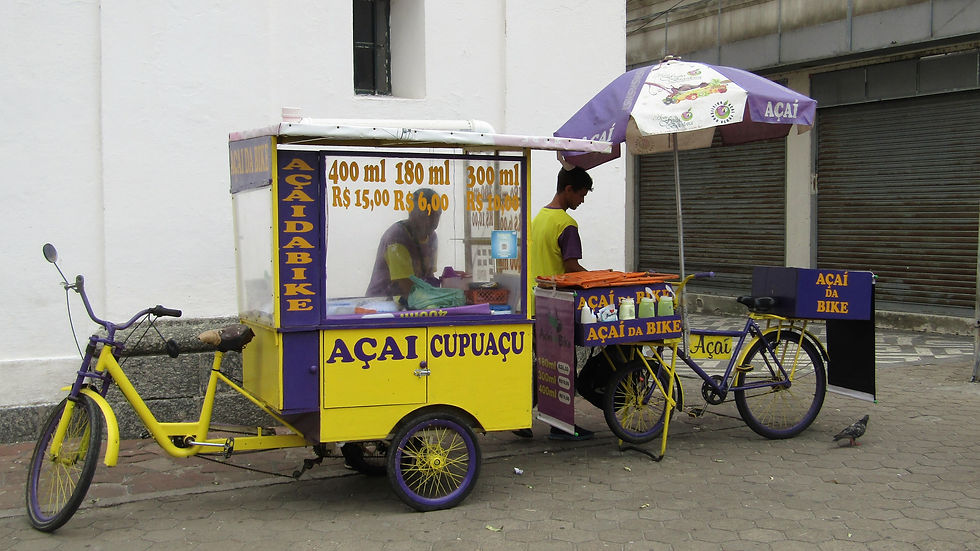
Fresh açaí juice, anyone?
Our last stop in Rio Grande was the Oceanographic Museum. It has an extensive collection of shells and sea life that has washed up on the shores, so operates as a research institute rather than an aquarium. It's also a rehabilitation hospital for sea animals; those ocean currents along the Atlantic coastline of Brazil are busy sea-routes for whales and other migratory animals. Each of these three penguins was found exhausted and starving on a south Brazil beach, and brought to the museum for rehab. They can't be released back into the wild until there is a group of about 20 penguins, so these dudes will need to wait for other stranded penguins before they can go home. They didn't seem too unhappy with their little holiday here --- and neither did a large turtle, who was also recovering.
Rio Grande was our last stop in Brazil on this journey. Ciao, Brasilia!
Next: Punta del Este, Uruguay


Comments