Paros, Greece
Updated: Aug 25, 2024
I liked Paros a lot. It has lots of tradition and practicality, sprinkled with a little glitz.
Paros is the third biggest of the 220 islands in the Cyclades.
We tendered from the ship to the main port Parikia, which is also where the big ferries come in. (Parikia, Paroikia. Spelling of Greek names in English is very variable.) Next to the quayside with the traditional church dedicated to Saint Nicholas, the protector of fishermen, the local fishermen mend and clean their nets. Weathered older men sit on their fishing boats drinking coffee with their friends, much as they would have done for hundreds of years.
Take your pick of vehicle. Quadbike? Dune buggy? Scooter? Crash helmet entirely voluntary.
Parikia had the same busy-busy-busy feel of Mykonos at the ferry port, with lots of people coming and going with suitcases, and plenty of cafés and (sigh) dress and jewellery shops to tempt the traveller ...
... but before long we were heading out of Parikia across the island to Naousa (or Naoussa).
Paros has a population of about 14,000 with 200,000 visitors in summer. Our guide Constantina told us that it's very popular with Albanians, who come in winter. Constantina was born, brought up and still lives on Paros. As we were driving between towns, her father drove past going the other way. Lots of friendly hooting and waving. It's that sort of place.

We thought Naousa was delightful, what we saw of it. Lovely beach, lots of restaurants around the marina, including one named for the pirate Barbarossa ...
... and again, those fishermen unloading their catches. Octopus, a Greek favourite, is tenderised by hanging in the sun and the fish (some kind of mackerel) is also sun-dried before cooking.
Honourable mention must be made of lemon and ginger gelato at this point.
Just around the corner from the marina was this marvellous corner of the ocean.

Our favourite sight, though, was the man with his large dog on his scooter. A smile for the camera, and off they went. I am inspired to try this with our puppy, but first I need a scooter.
Off they went, and off we went to Lefkes, a small town in the hills of Paros. Lefkes was originally the capital of Paros, built inland to protect the inhabitants from pirate raids. Lefkes nestles in the hills, between pine trees and olive groves, and the ground has been shaped into terraces over centuries.

There are a lot of very old olive trees, like this one, hundreds of years old. We also noticed throughout Greece lots and lots of prickly pear (cactus pear) plants, with prickly pears being sold at markets and on the street. I like prickly pears to eat but not to peel. As we all know, prickly pears are native to Mexico, but apparently the Venetians brought them to Greece during their rule. The Greeks call them French figs; they're valued in Greek cuisine so clearly they're not considered invasive and a nuisance. I guess that any plant that grows fruitfully (sorry) in these arid islands is appreciated.
Paros seems to support a more traditional way of life than we saw in Mykonos or Santorini. It is extremely dry, with very little rainfall, but there is ground water. Paros farmers plant bamboo wind breaks; the rows of bamboo are a very distinctive part of the landscape — as are the dry stone walls used to support the terraces and mark out boundaries.
Lefkes is a lovely little town, and quite peaceful as the streets are too narrow for cars. All traffic through the town itself is by foot.
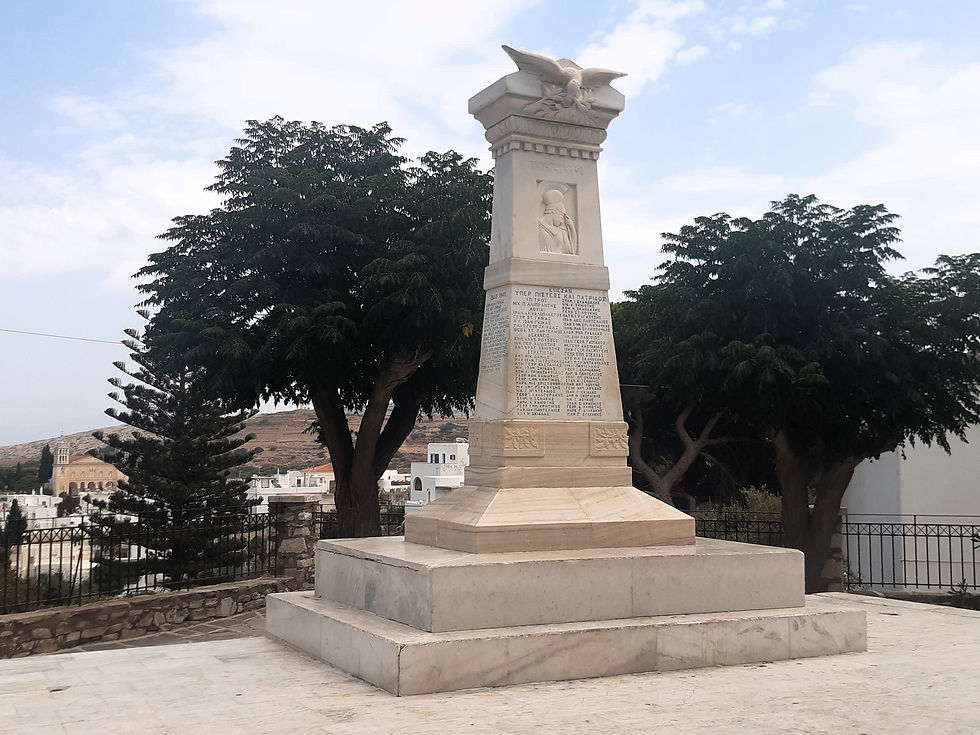
The war memorial commemorates the men from Lefkes who fell during the wars of the 20th century: the first and second world wars, the Greek civil war, the Korean war and the invasion of Cyprus.
About 20 years ago Lefkes hosted a conference for translators, which was such a success that the town is now a centre for translators and writers. The House of Literature is a building owned by the local council where professional writers and translators are hosted for three months, free of charge if they're a European citizen. If not, they pay €15 per day. Seems pretty reasonable to me.
The best marble in the whole of Greece came from Paros. It's called (surprise!) Parian marble.
Parian marble is pure white, translucent, flawless marble that was used by the ancient Greeks to make their best art, including the Medici Venus, the Venus de Milo and the Winged Victory of Samothrace. Oh, and part of the Parthenon. The original quarries were mined from the 6th century BC and can still be seen, but they are no longer producing marble.
Constantina talked rather scornfully of the marble from Naxos, the neighbouring island, with its yellowish colour and no translucence. If there's a Greek equivalent to 'Gah! Second-rate!', that's what she said. This is Constantina. She was a marvellous guide.
And so back to the port Parikia, and before we head back to the ship, a visit to the town's main church. Of course. The Panagia Ekatontapiliani ('church of the hundred doors') has some features from 300 AD so it's been around for a long, long time. There is a lot of gold and silver in this church, but I couldn't use flash so the photos are blurred. I've included one photo anyway of an icon of Jesus in silver armour — a Crusader saviour, as it were. We saw this image frequently, and it's intriguing in the context of the Crusades during the Byzantium era and their impact on the Greek islands. But more on that later as we get to Rhodes and Bodrum.
My ranking of our Paros experience, relative to the other ports: definitely 1st of the Cyclades islands! I enjoyed Paros much more than Mykonos or Santorini. I'd go back to Paros if I had the opportunity to do so.
More to come.


Fantastic - it all looks wonderful