Moorea, French Polynesia
Updated: Mar 17, 2025
Moorea is only 17 km away from Tahiti. Our ship left Tahiti at 5 am and we anchored in Moorea at 8 am. In fact, you can do a day tour from Tahiti to Moorea. The fast ferry takes 30 minutes, the slow ferry one hour, and (as a school student did recently) you can swim across in six hours.
Like Tahiti, Moorea is a high volcanic island circled with white coral beaches and crystal-clear lagoons. The name comes from the Tahitian word Moʻoreʻa, meaning 'yellow lizard'. Did we see any yellow lizards? No, but apparently they're common. Not common enough, clearly.
Moorea is about 16 km across, with a population of about 18,000 people (and 20 police officers). We drove around the whole island and it's a 60 km trip. On the north shore, there are two bays. The whole island looks like a flying bird, I think, but locals say it's heart-shaped.
The bay on the right of the map is called Cook's Bay. Captain Cook never came to this bay; it was named for the hotel of that name to attract tourists.
The second bay is Opunohu Bay, where our cruise ship anchored. There is no dock for cruise ships: other than Tahiti, all French Polynesian islands have tender ports.

The Polynesians always offer a welcome with music and flowers, and the occasional dog. I have learned that the flower is worn behind the right ear if you are partnered. If you are single, you wear it behind the left ear. Women wear open flowers, men wear closed flowers. Go figure.
Our guide today is a local Moorean called Tohi, who was young, enthusiastic and very chatty. (Not many people speak English in Tahiti or Moorea. 50% of tourists in French Polynesia come from the US, so English tour guides are needed but scarce.) Ronald, our driver, is Tohi's uncle. Tohi's great-grandfather was Swiss, he told us, 'which explains my light skin'.

The two bays are connected by a steep, winding scenic road. There is a lot of hooting happening as the vehicles approach the bends -- a kind of early warning system.
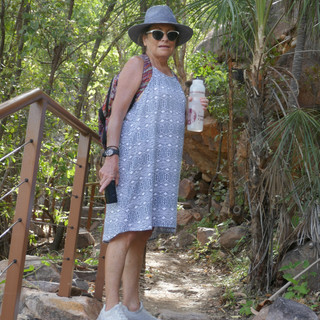
Early Polynesians built around 700 marae (temples/meeting places) in these valleys, but the ravages of Christianity and the bush mean that few have survived intact. This is Marae Tiirua in the Opunohu Valley. Along with the inevitable chickens. I asked Tohi if people eat the chickens. His grandparents did, he said, but it involves too much preparation for the younger generation ...
The trail continues to the Belvedere lookout overlooking Mount Rotui, Cook Bay and Opunohu Bay.

The French, British, Spanish and US all sent expeditions to Moorea in the 1700s and 1800s. Moorea did not have any native mammals but it did have insects, land crabs, snails (famous ones) and lizards. Settlers brought dogs, pigs, chickens and rats; unsurprisingly, native animals were wiped out. Tree snails have disappeared, and some of the endemic birds have been displaced by the common myna. (Which are everywhere, even in our garden at home!)
For the population of 18,000 people, 5 doctors (and 10 helpers, according to Tohi) work in the single hospital. That's during the week. Over weekends, there's one doctor. So don't get stung by a stonefish (as Tohi did) on the weekend. Treatment consists of plunging the foot into very hot water. If you don't get treatment, he says, you 'join the sky people'. I love that expression.
Food comes from the sea and fruit that grows naturally, like breadfruit, yams, taro, sweet potatoes, bananas, coconuts, and tropical fruits. There's very little farming. Coffee used to be grown but it's no longer profitable. On Moorea there's a freshwater shrimp farm, where locals can buy shrimp for $15/kg on a Wednesday.
The single commercial crop on Moorea is Queen of Tahiti pineapple. You can see the single plantation across the bay in the photo below. No chemical fertilisers are allowed so farmers use dried seaweed for the ammonia that's needed. (It's too difficult for women to pee on pineapple plants, Tohi told us seriously. Grapefruit trees yes, but spiky pineapple plants, no.)

We stopped at the Tiki Village, an area that has been rebuilt to show the style of life in traditional times. It includes a house where Gauguin stayed and some reproductions of his Polynesian art, but as I said previously, he's a bit on the nose to locals. Quick story about the canoes. No old canoes have survived as Captain Cook burned them all after the locals ate one of his two goats. So any 'old' canoe won't be more than a few hundred years old ...
I love the Moorean pineapple. It's super-sweet and crisp.
Adolphe Sylvain is a French-Tahitian photographer who became famous for his black and white photographs of Polynesian women. In 1946, he stopped off here in Moorea and stayed. It happens. If you have any South Pacific preconceptions involving scantily dressed swaying women, you have probably seen Sylvain's photos which were published everywhere in the 1960s and 1970s.
As pretty as the land is in these islands, the true beauty is in the sea. The ocean is crystal clear, the water is warm (30 degrees), there is no floating plastic or litter of any kind. There are hundreds of types of coral fish, friendly sharks, rays, turtles and humpback whales in summer.
Of course tourism is the most important industry for these islands. Tohi said that Moorea is still trying to recover after COVID; he implored us to tell everyone about French Polynesia (Moorea, mainly) and to encourage our friends and families to come. Consider yourselves encouraged!
Quick stories about two of the mountain peaks. The first, with the 3 m hole in the rock, is said to be a maiden lying down. The hole is her eye, and her hair tumbles down behind her. About the second peak, Tohi said that some tourists call it Bali Hai. Some of you of a certain age will remember the song from the musical South Pacific: Baliiii Haaaaai, you are calling, every night, every day ... The musical was based on James Michener's novel Tales of the South Pacific, in which Michener invented a mountain based on a mountain in Vanuatu. When the film was made, a mountain in Maui in Hawaii was used. This mountain looks just like the Maui mountain; their names are very similar and both mean 'long and thin'. (There is a point to this rambling story, i.e. about similarities within the Polynesian triangle, but I'll get to that later.)
France and the US both maintain research stations on Moorea, focusing on the long-term state of coral reefs. The US facility is called the Richard B. Gump South Pacific Research Station. Sadly, it's easy to imagine in the current political climate that Trump will dump the Gump.
The Moorea Sofitel looks like a resort where I could happily spend some time. It's the only hotel in the world with a lagoon that is 1 to 2 m deep all the way to the reef.
Finally, here are a few photos of the beach across the road from the Moorea hospital. An excellent spot for some recuperative R&R!
Next stop: Fakarava, French Polynesia
Are you reading this on your phone? Like most things, this blog looks better on a bigger screen. Launch your browser (Chrome, Edge, Safari) on your laptop or tablet and type in www.julie-anne.online. The latest post will always appear first.


Great blog. How wonderful to immerse yourself in the beauty of it all. You look relaxed and happy JA. By the way, I remember 'South Pacific' very well...and the songs. Photo of Ken? Snorkelling yet to come? Love Mary