Lord Howe Island (3)
Updated: Feb 14
We've been to Lord Howe Island before, in 2024.* We liked it so much that we have returned: not only to the island, but to the same accommodation, Pinetrees Lodge. They did a great job last time so they deserved a return visit.
Lord Howe Island is about 800 km northeast of Sydney across the ocean, and is part of New South Wales. No passports needed.
Has anything changed in the last two years? Not much, as far as we could see.
Lord Howe Island has a permanent population of 400 people and only 400 visitors are allowed on the island at any one time. Travel here has to be booked a long time in advance. The island has the southern-most coral reef in the world, thanks to the ocean currents that sweep down along the eastern Australian coast. It's a small island, about 11 km long and 2 km wide, and only 300 m wide at its narrowest point: the airstrip.

Australia takes biosecurity very seriously (remember the saga of Johnny Depp/Amber Heard and their two pooches?) and Lord Howe Island takes it up a notch or two. In 1928 a ship SS Makombo ran aground and black rats infested the island, decimating the native birds. (I described this in detail in one of my previous blog posts* – suffice to say that feral rodents have now been eradicated. Eraticated?) The island has three or four biosecurity dogs, one of which welcomes (aka sniffs vigorously at) all incoming passengers as they disembark the aircraft. One morning there was a ‘meet the dogs’ demonstration, to show visitors their sniffing skills. A dead rat was hidden in a bag and the dogs were asked to find it, one at a time. The sheer joy of these working dogs!

Now that rats and mice have been removed, the latest threat to the island’s biosecurity is the African big-headed ant. This unwanted immigrant came in on some cargo and has since started massacring the more peaceful Lord Howe native ants. So the dogs are being trained to find nests of African big-headed ants. The biosecurity officer noted that it’s difficult to tell the difference between native big-headed ants and the African intruders, but the latter have ‘blacker heads’. Make of that what you will.
A chilly southern wind, gusting from Antarctica, blew us from Sydney to the island, and continued to plague us for a couple of days. The wind chill is an issue when you’re sitting wet, in a boat, on the lagoon.
The average summer temperature on the island is between 20 and 26, so we’re not in the tropics exactly, but when the sun’s out it’s just perfect.
Some early morning yoga … The Pinetrees yoga/Pilates instructor is called Spanish Julia, because Pinetrees Lodge has another staff member called Belgian Julia. We noticed in 2024 how very international the hospitality staff are: young people working here from the UK, Europe, South America and the occasional Aussie.

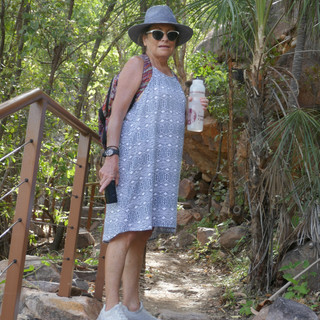
Last time we were here, I walked to the Valley of the Shadows on my own, where I got lost when I stepped off the path to film some woodhens. This time I thought I’d show Ken the same walk but without getting lost. Foolishly we took an alternative path by mistake and ended up climbing Transit Hill … so many fabulous hiking paths! So many opportunities for error!
The Transit Hill walk/hike/climb is a Class 3 walk: 'some bushwalking experience recommended; tracks may have short steep hill sections, a rough surface and many steps'. This one definitely has all those features. Plus a million plant and tree roots across the path, which makes placing one’s foot a conscious decision each time.
Here’s the 360° view from the top of Transit Hill. Altitude: 121 m.
Why is it called Transit Hill, you ask? This was the exact spot that Australian astronomers recorded the Transit of Venus in1882. There were two transits of Venus in the 19th century; this was the second and the subject of immense scientific interest all over the world.
We continued past Transit Hill downhill to Blinky’s Beach, where the sooty terns were nesting on the sand (no predators!) and were raising their (nearly grown) chicks. The chicks have spots in their feathers. More on sooty terns later in this post.
We sat there for a while, immersed in the birds wheeling around us. What a privilege.
Then it was uphill again (gah) and downhill eventually and then fresh fish for lunch. The food at Pinetrees Lodge is exceptional, and just as well, because our holiday was very active.
The island has no mobile network and wifi only at two local businesses, so no one is walking around glued to their phone. It's pleasant. Meals at the Lodge are entirely phone free.
Ned’s Beach is one of the popular beaches, where you can buy some fish food and feed the fish. It operates on an honesty system. Take or borrow what you want – fish food, wet suits, surf boards, masks or goggles – and pop the money in the tin. It was at this point that the pesky southern wind dissipated and the weather became just perfect.
There are very few cars on Lord Howe Island, mainly owned by permanent residents. Arrive on the island, hire bikes. I did notice a couple of mobility scooters hired by older visitors, but generally we all get around by cycling.
Luke and Charlotte went scuba diving off the little group of Admiralty Islands north of Lord Howe on one day; on another day, they walked up Malabar Hill and took this photo (last in the set below) of the islands from the ridge.
Ken and I finally tackled the hike to the Valley of Shadows and Clear Point, including Middle Beach, and this time, no one got lost. I loved the Valley of Shadows last time and it didn’t disappoint on a second visit: the combination of mature Kentia palms (native to the island) and banyan trees is stunning. From Clear Point, we could see Ball’s Pyramid – just over Ken's left shoulder in the photo below!
Ball’s Pyramid is a volcanic stack out in the ocean where the Lord Howe stick insect (a type of phasmid) was discovered in 2001 in a worldwide flurry of excitement, as everyone thought it was extinct. Ball’s Pyramid is 20 km from Lord Howe Island; it takes about an hour by boat because of the swell. Luke went diving at the Pyramid; he had missed out on this activity last time we were here because of weather. This time he was luckier.
We had an excellent view of Ball's Pyramid from the top of Intermediate Hill, altitude 250 m. Much higher than Transit Hill. We climbed Intermediate Hill last time we were here, and it's very, very steep. Definitely a Class 3 hike. Class 3.9! (It was on this hike in 2024 that Ken's hip gave up the ghost and he scheduled surgery on his return home.) We made it up this hill again, slowly (me), and at least this time the hill wasn't wet and slippery. Worth it for the fabulous view!
While we were admiring the view, Ken noticed a glorious collection of spider webs attached on one side to solar panels and the other to the trees. On closer inspection we discovered five or six big, beautiful iridescent green spiders, with very large bodies. These are golden orb spiders. I do love spiders. The close-up photo is by Ian Hutton, a well known Lord Howe naturalist. We didn't get that close because it would have involved climbing the trees.
One afternoon Ken and I took a tour to North Beach, a sanctuary zone that can be reached only by boat. (Or hiking over the mountains.) The tour included a bit of geology about the island's volcanic origins as well as natural history. Sooty terns are the most populous migratory bird on the island – about 100,000 arrive every spring – and at this time of the year they are finishing up raising their single chicks. They nest on the ground, have no fear of humans and have no predators on the island now that rodents have been removed.
The parents catch fish and then regurgitate the meal into the chick’s mouth. I was very patient, filming dozens of birds and chicks, on my knees in the sand, until I captured these moments of regurgitation. So I hope you enjoy them!
From North Beach, we walked across the island to Old Gulch, an inlet on the other side ...

... before snorkelling around two shipwrecks and turtle-watching. There are 7 types of turtles in the world; Australia has 6 of those types; Lord Howe has 3. This tiny little island has a relatively dense population of marine animals because it's influenced by three temperature zones: temperate, sub-tropical and tropical. The natural organisms around this island are adapted to temperature variations annually of 12 degrees; this has allowed the corals to resist bleaching as they’re more tolerant to temperature changes than (for example) the Great Barrier Reef, which is in the tropical zone and therefore acclimated to a narrower range of temperatures.
We saw about ten green turtles, both underwater and surfacing for air. The spot we visited is a turtle-cleaning location: turtles visit this area to be cleaned by certain fish in a symbiotic relationship. It's great to see them from the boat but even better when one's snorkelling! It was perfect snorkelling weather for me: calm, warm, low tide.
Here are a few more views from the north of the island, looking south towards Mount Gower and Mount Lidgbird. These are from Luke and Charlotte's hike to the top of Malabar Hill.
A picnic barbecue is one of the lunch options offered by Pinetrees. Fresh kingfish (or your choice of barbecue-able foods) and all the trimmings are delivered to your chosen barbecue spot somewhere on the island.
An afternoon at the lagoon beach ... Luke and Charlotte paddled across to Rabbit Island (and climbed it, and waved at us), Ken snorkelled and I lazed in my inflatable tube, while a turtle popped up for air about a metre away from me.
Sunset drinks at the Boatshed, across the road from the Lodge.
And then, it was time to go home, and to leave this perfectly formed, perfect small island. The videos of take-off are such fun that I've included both Charlotte's and mine, as we were sitting on different sides of the plane. Till next time ...
PS An excellent First Dog in the Moon cartoon, displayed in the Lord Howe Museum. Love this cartoonist. https://firstdogonthemoon.com.au/

*These are the posts from last time we visited Lord Howe:
This post really looks better on a bigger screen. www.julie-anne.online


Comments