Hue, Vietnam
- Julie-Anne Justus

- Oct 17, 2024
- 7 min read
We travelled by train — overnight — from Hanoi to Huế (pronounced hway). When Vietnamese is spoken, it has six tones, almost impossible for a foreigner to get right, and the written language is splashed with diacritics. Rather than writing Huế every time, I'll just type 'Hue' from here on. (Do not pronounce it 'Hugh'!)
Our train left Hanoi Railway Station at 7.30 pm and we arrived in Hue at 9.15 am. We had a two-berth sleeper car, which was pretty comfortable if you like hard beds. Shared bathrooms were a challenge but hey, it was only one night. Travel's an adventure, right?
Hue is in Central Vietnam.

Hue is an ancient city that was the imperial capital of Vietnam during the Nguyen Dynasty from 1802 to 1945. Yes, this included the period of French rule. The Nguyen Dynasty were the royal family of Vietnam, and this is where they had their home.
Does this mean the Nguyen king/emperor actually ruled Vietnam during this period? No, the French did. But the Nguyen 'kings' were the puppet rulers, the figureheads from the past. It all came crashing down after World War II when Vietnam declared independence. Briefly. The last king was an interesting character — but more on that later.
Our day out in Hue was led by our fabulous local guide Mimi. Like all of our young guides, she'd studied tourism at university, where the students can select a major language. If they select English, they can choose American English or British English. Most students choose American English because (a) there are so many American movies and videos on the internet that they can use to support their learning and (b) they find the various dialects/accents of British English hard to understand. Well, yes, even native English speakers find some UK variants a challenge!

Our first stop was the Thien Mu Pagoda on the bank of the Perfume River. The legend tells of an old woman who predicted that a great king would come and build a Buddhist pagoda and the country would prosper. The local Nguyen lord/warlord (at that time, in 1601) obliged and called the pagoda the 'heaven fairy lady' pagoda. Ah, female stereotypes! Thanks to this mysterious history, it's always been a popular spot for local and foreign tourists.
The tower at the centre of the pagoda has seven storeys and is the highest stupa in Vietnam. It's the unofficial symbol of Hue.


As you probably know, statues of Buddha can take one of several positions. There is the seated Buddha (attaining enlightenment), the standing Buddha (readiness to help), the walking Buddha (fearless and brave) and the reclining Buddha (final moments before Nirvana). There are also statues of Buddha with different hand gestures.
Then there are different statues of Buddhist disciples — not Buddha himself. The happy Buddha is one of them. He's an eccentric figure. He's always laughing, is fat and jolly, and has a huge tummy. This depiction represents abundance or forgiveness. We started noticing him everywhere in Vietnam. Which would be appropriate, as the Vietnamese people have a lot to forgive.


The gardens at Thien Mu Pagoda were wonderful. I think I have already mentioned how dazzled we were by all the bonsai trees wherever we went in Vietnam. The gorgeous red flower is from the cannonball tree, a tree commonly planted in religious sites.





As beautiful as it is, Thien Mu pagoda has a grim history. President Ngo Dinh Diem rose to power in 1955, following the departure of the French. But he favoured Catholics and discriminated against Buddhists in the army and government. Mass protests exploded in Hue in 1963; Thien Mu pagoda was an organising point for the Buddhist movement and was often the location of hunger strikes and protests.
In May 1963 government soldiers fired on Buddhists celebrating Buddha's birthday and killed nine people. In June 1963 a monk called Thich Quang Duc from this temple drove to the centre of Saigon (as it was then called) and burned himself to death in protest. The photos went round the world and for many foreigners, this was the first time they'd even heard of Vietnam. (The knock-on results of this event were significant; I've provided a link if you're interested in this period of history leading up to the American War. I am, very, but it's complicated and I have too much else to write here.)
The third photo below shows Thich Quang Duc's heart which was miraculously unburned and was kept as a relic by the monks.





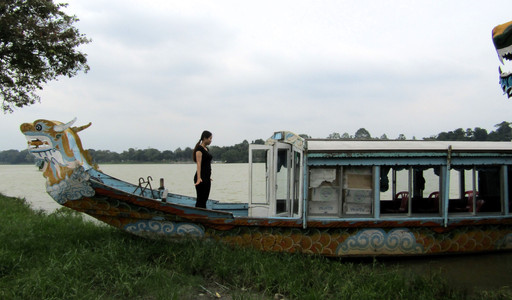
Onwards to a short cruise along the Perfume River. With dog. It's called the Perfume River because the banks used to be lined with frangipani trees on both sides. Sadly, what with war and development, the frangipani trees have largely disappeared (as has the perfume).


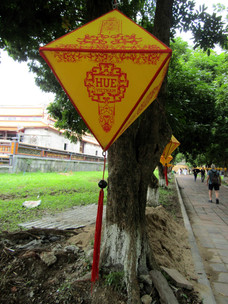
I was struck with this photo of this quiet street in Hue with only one motorbike. Remember this oasis of tranquillity when we get to the maelstrom of Ho Chi Minh city!

And then to the Complex of Hue Monuments, including the Imperial City. The Complex is a UNESCO World Heritage Site. About 4 million tourists visit the site every year. However, Hue was the site of a major battle in the American War, during the Tet Offensive, and a great deal of this site was damaged. It's being restored, but slowly, as the funding becomes available. Only the pink blocks on this map are still existing (or restored). Everything else, other than the walls and moat, were destroyed during the fighting.

The complex is surrounded by thick walls and a moat.


Now, we may look pretty posing against the moat, but we had nothing on all the beautiful young people dressed in traditional and/or historical clothes — who were happy to pose for me too.


Through the main entrance, and into the extensive grounds ...



The Royal Theatre has been restored many times. Much of it is a replica but it does include some artefacts from traditional Vietnamese theatre, which reminded us of Japanese kabuki with its elaborate costumes and colourful masks.


The Forbidden Purple City was once the emperor's home. Like the Forbidden City in Beijing, its purpose was seclusion of the royal family and virtual imprisonment of the royal wife and hundreds of concubines to ensure the purity of royal line. But unlike the Forbidden City in Beijing, which is quite confined and has very little green space, this had the most glorious garden with (yes) many, many beautiful bonsai trees. I hope you appreciate my restraint in including only seven photos of the garden below!


Our final stop in the Imperial City was Kien Trung Palace. Completely destroyed in 1946, this palace has been rebuilt, and has been open to the public only since the start of this year. Emperor Khai Dinh (who was a staunch Francophile) starting building it in 1921. When he died, his son Bao Dai continued the construction. It's a bit of a Versailles situation — the last kings building extravagant palaces, doomed by changing social conditions, by political revolution.
Like Louis XV, and like his own father, Bao Dai had an extravagant lifestyle. He inherited the throne when he was 13 years old, was educated in France, and was famous for nightclubbing, shopping and playing tennis. The three photos below show Bao Dai, his wife and his son.


In the turmoil of the Indochina war, Bao Dai was France's (and later, Japan's) puppet king. In 1945, when the Vietnamese declared independence for the first time, Bao Dai abdicated his throne. He left Vietnam and spent the rest of his life quietly and in relative obscurity in Hong Kong and Paris.
Social qualms aside, it is a splendid palace! Redolent of the palace of Versailles! It's been restored and is very popular with local and foreign tourists.


It's not difficult to imagine these surroundings at their peak, with elegant men and women parading in their finery through the gardens.





To help you picture palace life, I've helpfully provided a photo of some lovely young women dressed up in traditional costume, posing in the palace. There is a lot of social media happening in these historic sites!

Emperor Khai Dinh wasn't only concerned with enjoying his life. He was interested in having a good time after death, too. (Honestly, these emperors/pharoahs/kings!) So he commissioned a mausoleum for himself. It took 11 years to build and sadly it wasn't ready for him when he died, but it is a glorious temple. Whoops, tomb.


The main part of the tomb is a five-roomed palace. Yes, it's actually called that. A palace for the dead. It's very ornate, very colourful, in French colonial style, with geometric designs, dragons and longevity symbols (important when you're dead ...) as well as a nod to Confucius. I did admire the beautiful glass and porcelain decorations, which seemed quite distinctive to me.


This tomb/palace also contains a collection of Khai Dinh's personal memorabilia, including photographs, jewels, swords, ornaments and gifts from the French government. There's plenty of Sevres and Limoges on display. Such conspicuous consumption! Can't you just hear the the rumble of the tumbrel and the clatter of the guillotine?
Qualms aside, the tomb is set in a beautiful location.


A final stop at an incense village, where we were shown (and re-shown) how to roll incense around thin sticks. A feast of scents, smoke and colours!


Just a few photos of the wonderful food we had on our journey. These dishes are from Hue: duck salad in banana flowers, prawn and pork skewers with rice paper, fresh fish.


Special mention must go to the glorious tapioca prawns. They have the taste and texture of little savoury Gummi Bears. They're usually steamed in banana leaves, in small parcels. I love them —but they were not for everyone!


I know this has been a marathon post, so if you're still with me, thank you.
One last observation. It's impossible to travel in Vietnam without thinking of the wars it has suffered. And Hue? The battle of Hue in the American War, during the Tet Offensive in 1968, was one of the longest and bloodiest in the war. From the Vietnamese perspective, almost 1000 civilians were killed and 80% of the city was destroyed. Most people were made homeless.
From an international perspective, the battle of Hue changed the American public's perception of the war. The American public was shocked by the strength of the North Vietnamese and Viet Cong forces, particularly as they had been hearing that the end of the war was in sight. Optimistic US government reports were contradicted by journalists as they reported first-hand on the combat. The final straw was when Walter Cronkite visited southern Hue, and commented (on TV) that the war would end in a stalemate. He was right, but it would take five more bloody years of fighting before the US withdrew from Vietnam.
Onwards, further south, to Hoi An.


Comments