Ha Long Bay, Vietnam
- Julie-Anne Justus

- Oct 10, 2024
- 6 min read
Updated: Oct 22, 2024
It's 180 km from Hanoi to Ha Long City. The drive is through low plains, rice paddies and a lot of standing water — unsurprising as the area (including where Hanoi is now situated) is low-lying. It was under the sea for thousands of years.

But it's also unsurprising as Typhoon Yagi hit this region three weeks ago, leaving 260 people dead. Ha Long City is still clearing up.


Ha Long Bay is a UNESCO World Heritage Site. It's a bay that contains thousands of islands, many of them limestone pillars that stand out of the sea. Remember the James Bond movie Tomorrow Never Dies? That was filmed in Ha Long Bay.


We set sail (metaphorically speaking) on an Indochina junk, Prince 2, that takes 8 passengers. There are 4 double guest cabins with private bathrooms. The cabins are smallish but luxurious. There are 7 staff members: the captain, the chef, the bar and food servers, the mechanic, the young man who helps with the tender boat — and our guide and interpreter, who was given the nickname Smiley a few years ago by some guests. And smiley he is! The photo below shows the Prince 2 junk with its sails unfurled, but this was for the photo. We sailed by engine, not by wind.
A word about 'junk'. Smiley hastened to remind us that in this context, a junk is a Chinese sailing vessel. So I am going to continue to use this term without any hint of double entendre.


After all the turbulent weather a few weeks before, we were delighted to sail (motor) out of Ha Long city port on a beautiful day.
Vinh Ha Long (Ha Long Bay) means 'where the dragon descends to the sea'. In ancient legend, a dragon tore through the earth with such force that mountains crumbled, forming large valleys that soon filled with water. Only the peaks of mountains — now the rocky islands of Ha Long Bay — remained above the surface. The modern legend has it that Tarasque, a dragon-ish creature, still inhabits the bay. A type of marine Loch Ness Monster?
The limestone towers are called karst. The karst towers in Ha Long Bay have been partly formed by marine erosion over 20 million years and this makes them unique in the world. Thick jungle vegetation grows on the islands, and many of them have caves. We visited the Thien Canh Son Cave, which has a a small landing area for the boat's tender.

Inside the cave, stalagmites and stalactites have formed over centuries. In some areas local people have broken off the limestone columns to use for building. It's now all protected.


The cave extends through the whole karst island. We walked through the karst and out the other side, emerging to this view. That's Prince 2, our junk, to the right.


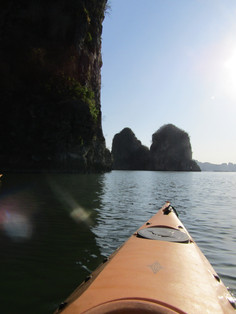
Having explored the cave, our next activity was kayaking around one of the islands. The kayaks are moored/stored within an (almost) circular island.


We tender from the junk to the kayak platform. Ha Long Bay is quite shallow, and on this day perfectly calm, but we had to don our life jackets for each three-minute tender trip. I'm not complaining, I appreciate the regulations, but I'm not sure whether Ken in the photo below would be helped or hindered by his unfastened life vest!
Two men and their two dogs live aboard the kayak platform. There is a small house where they cook and sleep. They hunkered down in this site (with their dogs) during Typhoon Yagi. They were lucky to survive.




And we're off in our trusty two-person kayak.




We had a friendly group of passengers on the two-day cruise: two Australians, two South Africans, one South African/Aussie/New Zealander who lives in Dublin, one Irish person, and two Dutch people. It was delightful. We had a lot of fun. (And a lot of wine and beer and many cocktails were drunk.) Harriet and Bert, the older Dutch couple (on the right of the photo below) had done a week's hiking through north Vietnam with a guide. Going into remote areas, they spent each night at a local family's home. Homestay tourism is popular in Vietnam — it allows tourists to see rural Vietnam and supports rural economies without the need for infrastructure development of more formal lodges or hotels. Harriet told us about going to bed at the same time as their hosts (shortly after sunset), sleeping in the same room as their hosts, eating the local food, often very simple, drinking happy water, and rising at sunrise at 5 am. Happy water is rice wine that is home-brewed and flavoured with various extras such as flowers and dried lizards.
A homestay must be a wonderful opportunity to experience local culture that has been relatively unchanged for centuries. It's not for me, though. I like my little modern luxuries such as a flush toilet. I asked Henriette whether the local people had TV. No, but everyone has a mobile phone!

On the subject of food, our meals on board Prince 2 were outstanding. We asked for the chef to come up from the outdoor kitchen on the back of the boat to meet us, then we applauded him. He looked about 14 years old, and was adorably bashful about our praise.


The food not only tasted wonderful but looked great too. And we had an opportunity to cook! We had a cooking demonstration (Vietnamese crispy pancakes) and then the chef presented us with carved vegetables and fruit. According to our guide Smiley, the hospitality colleges hold a prestigious food carving competition every year, with the winner being celebrated regionally. We had noticed food carving in Thailand, but clearly it's valued in Vietnam too.


And then it was sunset.


We had an excellent night's sleep on the water. Then we woke up, had a glorious breakfast and visited Vung Vieng fishing village. The village has been in this area for around 200 years, and was originally used as an anchorage for fishing boats to ride out storms. Gradually people began to live aboard this village and by 2014 there were 80 families living here permanently. To be blunt, this is not a good idea with no sewage or waste facilities, and the Vietnamese government became concerned at the environmental impact on Ha Long Bay. But tourists liked seeing the fishing village! So a compromise was reached, and the villagers were moved onto land (not without a few grumbles), leaving the village intact as a place for tourists to visit.
Today there is a strong focus on aquaculture. The villagers grow oysters, both for food and pearls, and continue to fish as they have for centuries.
We hop onto a local boat and a local villager is assigned to row us around the area. Our friendly oarsman was responsible for our boat of four passengers; his wife was the oarsperson on the other boat.


We row past the village, which floats on large plastic barrels attached to the occasional mooring. The village dogs — plenty of them — stirred themselves from their morning naps in the sun to bark at us. An interesting life for a dog, perched on floating barrels and barking at the dog next door across the water!


One of the islands has an arch that's been carved out of the limestone by the waves and currents. The correct name for this geological feature, according to Smiley, is a marine notch.


It did strike me during our kayaking and rowing adventures that we should be on the lookout for unexploded mines laid by the US Navy during the American war. Unexploded ordnance continues to take a toll all over Vietnam. But on this occasion we returned safely, unmined, to our junk.
Mines are one thing; plastic rubbish is another. Of course, it's not just the floating villages that have polluted Ha Long Bay. Population growth, construction along the bay, industrial waste and tourism have all affected the bay. It's distressing to travel in such a beautiful area and see a floating plastic shoe and a plastic bag every few hundred metres. The worst are the small bubbles of polystyrene that have been broken off bigger chunks and float along the surface of the water.
Prior to COVID, when tourism was more stable, many tour companies issued small nets to tourists so that everyone who visited Ha Long Bay could help by scooping out rubbish from the water. I think that's a great idea. The government has also created employment in local areas by paying ex-fishermen to clear floating rubbish. So the situation is being addressed, but plastic is persistent ...
Then it was time to head back to Ha Long city and to Hanoi. On the way to the city, we stopped at a small rural town, Yen Duc, surrounded by rice paddies.

Yen Duc is well known for its traditional water puppet shows. First two traditionally dressed women entertained us with traditional song.


Water puppetry has been part of Vietnamese culture for hundreds of years. Originally performed in flooded rice paddies after the harvest, small stages next to ponds or small lakes are used. The puppeteers stand in water throughout the show, and manoeuvre their lightweight, painted wooden puppets through the water. The stories are simple (obviously we couldn't understand the language of the story) but we saw farmers with their water buffalo, dragons and dancing birds.


Here's the lovely crew taking their bow.

I will take my leave here too. Next: southward to Central Vietnam, and the town of Hue.


Comments