Delphi, Greece
- Julie-Anne Justus
- Sep 7, 2023
- 5 min read
Updated: Aug 25, 2024
We took a day trip to Delphi, about two hours drive from Athens. We leave the city behind and we are soon in the rural countryside, where farmers grow corn and watermelon. The mountains — real mountains, not hills — loom in front of us.

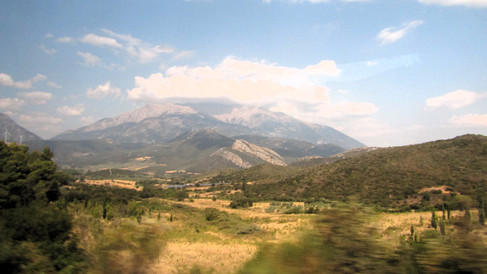

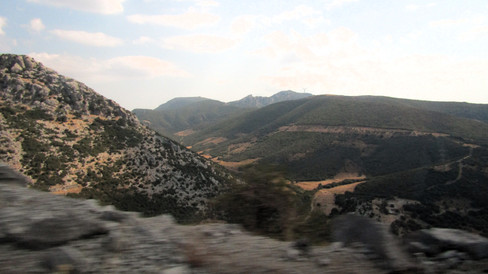
Delphi is situated on Mount Parnassus, the second tallest mountain in Greece at 2,500 metres. It's a favourite ski retreat for Athenians in winter.
To understand Delphi's historical signficance, I'll recount the story that our guide Sofia told us. Bear in mind that Delphi has a contested history, with experts spending lifetimes haggling over details. But here's a simple version. Around 1000 BC, the mountainous site was the location of a cult that worshipped the Earth, or Gaia. The beliefs included the worship of snakes, which were prevalent in the area. Snakes are of course closely in touch with the Earth and were therefore sacred.
By the time of the ancient Greeks, around 500 BC, the cult of the Earth had been replaced by the pantheon of the classical gods. In classical mythology Apollo slew the dragon or snake (the Python, in Greek) that guarded the site. In other words, the one cult superseded the other. As the triumphant invader, Apollo became the deity of the site and the temple was erected to honour him.
But why that site specifically? The story goes that a goatherd lost a goat on the mountain. He eventually found the goat but the goat was behaving strangely, dancing and prancing like, well, a giddy goat. The goatherd followed the goat into a cleft in the rock and became rather giddy himself. This was identified as the 'navel of the world', the centre. Scientists know now that hydrocarbon fumes from a fissure in the earth's surface (earthquakes!) produce hallucinations — but at the time this was interpreted as sacred inspiration.
The temple was built for Apollo — the god of music, poetry and dance, truth and prophecy, healing and diseases, the sun and light. The oracle/prophetess/sibyl was called Pythia, and she would deliver prophecies after inhaling the fumes. The priests of the temple would 'interpret' her gobbledygook for the ordinary people, who made offerings at the temple in order to hear their fortune.
The navel of the world (or the centre of the universe) is symbolised by the oval rock, the omphalos. There are multiple omphalos stones at Delphi. But the place where Pythia sat to receive the divine inspiration, i.e. to get high, was here at this V or heart-shaped rock.


By about 400 AD, the Romans (and earthquakes) had destroyed the temple and anyway, the intoxicating fumes had dissipated and the Oracle of Delphi's magical powers had gone.
Sofia was an excellent guide, with excellent English, but the Athens accent pronounces 'god' and 'goddess' as 'gad' and 'gaddis'. I was quite puzzled initially what the gadapollo and the gaddisathena were, but I got (gat?) it eventually.




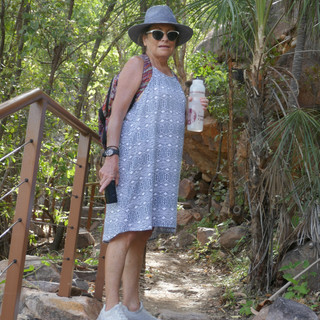
To explore Delphi, we have to climb the mountain. Take good shoes when you go.
We start off at the first level of site. Before we reach Apollo's temple, we walk through the old stoa or marketplace. This is where people would buy offerings for the gad. God. You would never visit the temple and ask for a prophecy without making the appropriate offerings.



Which makes the function of the next (many) buildings completely logical: these were treasury buildings and each city-state had their own treasury. A treasury was built to celebrate victories in battle, to thank the oracle for her advice (that no doubt had helped them win the battle ...) and to store the offerings to Apollo. Ten per cent of all battle winnings, thank you.


The Athenian Treasury has been restored. It was built to commemorate the Battle of Marathon around 500 BC. A great victory, except for the runner who was sent to deliver the good news to Athens 42 km away.


We climb a few levels higher up the mountain and here it is. The remains of the Temple of Apollo.


Climb even higher and there's an even more stunning view. We've seen some gorgeous architecture but the location of this temple, in these high mountains with valleys below, is just incomparable. Add a bit of magic to the mix and it's not difficult to see why this place drew people from far away. And still does!


Above the temple ruins is an amphitheatre ...


... and even higher up, a sporting arena. Ken reached the sporting arena on his own. I'd climbed high enough above the amphitheatre.
Have I mentioned feral cats before? They're everywhere in Athens, and here they were in Delphi too. Lots of cats wandering around the site, including a few tiny kittens that we spotted peeping out from inside a wall.


The museum on the site contains all the artefacts that have been found on this site (apart from those artefacts that were looted and are now in foreign museums), including prehistoric clay figures and gold jewellery for the gods. The gold jewellery was set on full size sculptures of the gods made from ivory. Ivory? Black? These figures have been burned in wildfires over the centuries. Ivory turns black when it's burned, apparently. The figure on the left is Apollo; the figure on the right is his twin sister Artemis.


The museum contains some significant artefacts ...


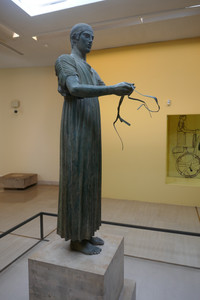
... but probably the most signficant and most well known by Greeks is the Charioteer. It's the only remaining bronze figure from the temple, the many others have been melted down for coins or tools or weapons, or stolen and moved elsewhere. The Charioteer survived because it was buried under a rock-fall at Delphi. It shows the young man after the chariot race, when he's victorious. A few pieces of his chariot also survived. Those of you into fashion will recognise the style of garment (lots of pleats!) that designers created, called the Delphos, after this statue.



There's another temple in Delphi, the Temple of Athena Pronaia. It's down the road from the Temple of Apollo, about one kilometre away, and it was intended to be visited on the way to Apollo. Of course! Athena is a woman, and therefore less important than Apollo. What's really famous about this temple is the Tholos, the circular part of the temple.

On the way back to Athens we stopped in a mountain town called Arachova. In winter this is the centre of ski culture. Lots of shops hire ski gear and it's easy to imagine the gemütlichkeit of après-ski in this beautiful environment.


No snow for us in mid-summer, obviously, but we did enjoy Greek coffee and excellent tyropita. It has the narrowest of old streets, impossible for two coaches to pass by each other. Much manouvering necessary to retain side mirrors and the old buildings!


Back to Athens, and from there on the cruise ship to the Greek islands. Some of them, anyway. Greece has 6,000 islands scattered in the Greek Seas, of which only 227 islands are inhabited. And we'll be visiting only five (plus one port in Turkey), so just a little, tiny taster.
More to come from the wine-dark sea.


Comments