Crete, Greece (1)

Updated: Aug 25, 2024
In Greek mythology, the minotaur was a monster with the head of a bull and the body of a man. The minotaur was the shameful offspring of King Minos's wife and a white bull, and was kept hidden in a labyrinth. Every year, a group of young people were sent into the labyrinth and sacrificed to the monster.
One year, the Greek hero Theseus — assisted by Ariadne, the daughter of King Minos — reached the centre and slew the beast. Ariadne had given Theseus a sword and a ball of thread, so that he could find his way out of the labyrinth. (Theseus then marries Ariadne, casts her off, she marries Dionysus and eventually is turned to stone. But that's another story.)
The minotaur, the labyrinth, King Minos, Theseus — legend has it that this takes place in Knossos, the king's palace in Crete. And that's where we are now. Knossos is the second most visited historical/archaeological site in Greece, after the Acropolis. It's not far from the port of Heraklion (Iraklion in Greek) in Crete.
The site was first excavated in the late 1870s by a Greek archaeologist. The politics of the time were complex (surprise!) and he was concerned that artefacts found at the site would be sent to Istanbul, so his excitement was muted. But great finds were being made around the Mediterranean, and there was a network among archaeologists, so enter Sir Arthur Evans, a British archaeologist at the Ashmolean Museum, who came to Crete to see what was happening. Politics? No problem. Evans bought the land and the great city of Knossos thus became his private property.
And gosh, did Evans have fun. In 1900 he started digging with great enthusiasm, and as he unearthed the site over the next couple of decades, he and his workers started 'restoring' it — with concrete and iron. In the fascinating choice between restoration or conservation, Evans took an aggressive restoration approach.
So why is restoration problematic? First, deciding how something looked fixes the site at a point of time, when actually the site has a long occupation and how it was used may have changed over time. Second, interpretations and scholarship (and science) may change over time, so it's better for a site to be conserved to allow new theories and understandings to develop. And third, any restoration needs to be non-destructive and reversible.
So concrete is a bit of a problem.
In defence of Evans, said our guide Evangelina, the palace of Knossos was crumbling and neglected. Built from limestone (no marble here!) that erodes easily, the site would degrade relatively quickly as it was excavated and exposed. There's certainly a lot of eroded limestone on the site, it's true.
But what ho, it was 1900, Arthur Evans owned the site, and he could jolly well do what he wanted. He was also motivated by the desire to showcase his new excavation and make the most of the burgeoning tourist interest in antiquities. Don't forget that the world was being wowed around this time with archaeologists unearthing Troy, Machu Picchu and Tutankhamun's tomb — interrupted for a few years by the First World War.
Arthur Evans named this civilisation 'Minoan', after King Minos, because the palace included many images of bulls and this reminded him of the Greek myth of the minotaur and the labyrinth. What the people in this 'Minoan' civilisation called themselves is unknown. They had a written language, now called Linear A, that has never been deciphered. A later version, called Linear B, was accompanied by some Mycenean writing, so that has been deciphered (shades of the Rosetta stone), but there's a lot that remains obscure.
Evans also decided what the buildings had been used for and what the culture had been like. Many of his theories have been challenged in the last century. What is accepted is that the Minoans were a Bronze Age society, from about 3000 BC to 1100 BC. The Bronze Age society on the Greek mainland at the time were the Myceneans; the Minoan civilisation flourished centuries before the ancient Greeks as we know them.
(The Knossos site goes back to about 8000 BC but we'll focus on the Minoans.)
The Minoans were closer to the Ancient Egyptians than to the classical Greeks. Proximity was a factor; trade forged bonds, and the Minoans were deeply impressed by Egyptian art and technology. Ancient Egyptian influence is very clear in many of the Minoan artefacts and designs. These Egyptian-style frescoes were used to tell the public how to behave at Knossos, a kind of 'what to do' list in pictures.
Was the palace of Knossos a palace at all? The site covers about five acres, and it's now agreed that the central buildings were probably used for state and ritual purposes. The other buildings had more functional purposes. For example, the first photo below shows the 'west magazine', a corridor joining 18 storerooms. The storerooms contained jars and chests probably holding oils, wines and pulses. Many of the buildings on site were work spaces, places where artisans and craftsmen could create and build items for trade.
And trade they did. Unlike their arid Cycladic neighbours, Crete produced oil, wine and wool. Minoan pottery and stone vases have been found in Egypt, Syria, Turkey, mainland Greece and many of the islands.
The palace had bathrooms, toilets and a drainage system.
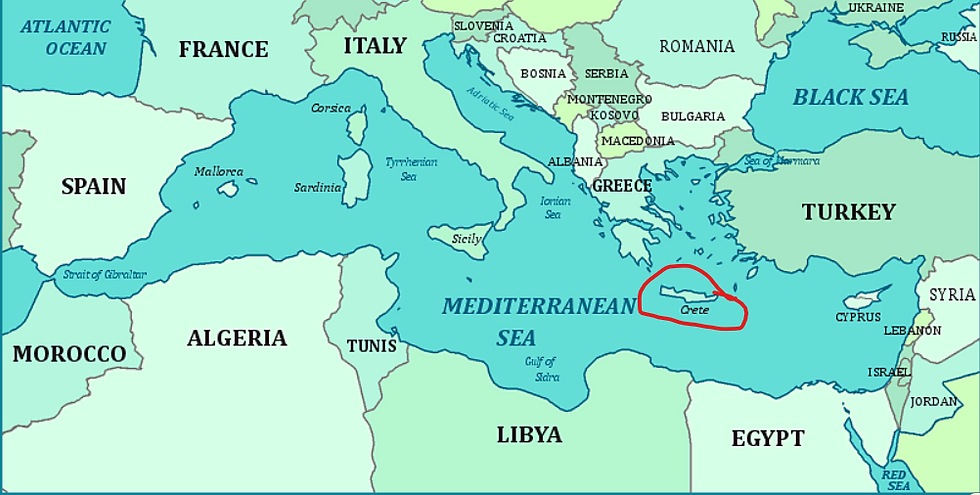
The Minoans were Europe's first advanced civilisation. Were they Greek? Evidence suggests that they were a mix of people from the Middle East, Greece and north Africa. Crete has a very handy position. It's bang in the middle of the Mediterranean Sea, and has been a staging point for exploration and a trading centre for centuries.
Well, the Germans knew about its strategic value during the Second World War.

What would a palace be without a theatre? The theatre at Knossos is rectangular, unlike the later ancient Greek theatres. This theatre would have held a few hundred spectators and was probably used for religious events. The road that stretches beyond the theatre ends up at the High Priest's temple or house, so he could walk from there to the theatre very easily.
That's assuming that the High Priest was a man. One of the interesting questions at Knossos is about the role of women. One theory suggests that the ruler of Knossos was actually a woman, and certainly the art supports the idea that women occupied positions of power.
The Minoans produced the most extraordinary, highly advanced and exquisite frescoes.

Many of the frescoes at the palace include images of bulls, so it's not hard to see why Evans thought of the minotaur. The Minoans enjoyed the sport of bull-leaping, illustrated in the fresco in the second photo below. Participants threw themselves at a charging bull and somersaulted over its back, thus proving their worth. This was a sport for both men and women. In Minoan art, women are painted in white and men in brown.
Some of these frescoes have survived in their original state. But Evans hired some painters to repaint others. This is (what Evans called) the throne room. It's been 'retouched'. How much is based on traces of colour already there, and how much on the imagination of the French painters in the 1920s, is the subject of much discussion. What has survived intact is now preserved in the museum, which we will get to in due course.

So after all this, where is the labyrinth? There isn't one. Like many myths (remember Delphi?), the ancient Greeks needed to explain the civilisation of Knossos, its symbols and its religion, which had been superseded by the Greek pantheon. So they created a myth that recognises the bull iconography of Knossos, turns the city of Knossos into a labyrinth, and puts Theseus, the archetypal Greek, into the position of hero.
In our next episode, thrillingly entitled Crete (2), I'll share some more experiences about Crete, including the archaeological museum in Heraklion — yes, more Knossos and Minoan stuff (I love it) — and a visit to a traditional Cretan village.


Comments